


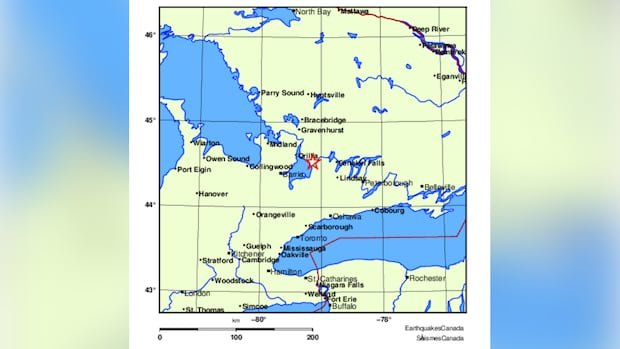

Thousands of individuals residing in southern and central Ontario reported being jolted by an earthquake late on Tuesday night, as confirmed by Natural Resources Canada. The seismic event, measuring 3.7 on the Richter scale, was detected by Earthquakes Canada approximately 99 kilometers northeast of Toronto just before 11 p.m. ET.
The tremor, described as “lightly felt,” originated 23 kilometers southeast of Orillia, Ontario, and occurred at a depth of five kilometers. According to seismologist Marikah Adams from Natural Resources Canada, around 2,600 people have already reported feeling the earthquake, with reports continuing to pour in from locations as distant as Kingston to Kitchener.
Sarah Cowley, an artist based in Beaverton, recounted hearing a loud noise reverberate through her century-old home as the quake hit. Although her old yet sturdy home’s floors shook, she observed no visible damage outside her window.
Despite being rattled by the quake, Cowley mentioned that her husband slept through the entire episode. The “Did you feel it?” link on the website received over 2,000 reports from individuals who sensed the rumble, stretching from Kitchener in the west to Toronto, Belleville in the east, and Niagara Falls in the south.
While there were no immediate reports of damage or injuries, historical data from Earthquakes Canada indicated that the same area had encountered two earthquakes of comparable magnitude in the past 25 years, with the most significant one being a magnitude 5.5 quake in 1929.
The unusual seismic activity in the intraplate region of the North American plate surprised experts like Adams. She expressed uncertainty about any potential aftershocks but deemed it highly improbable. The cause of earthquakes in this specific area remains less understood compared to regions near tectonic plate boundaries.
Lindsay Schoenbohm, a geologist at the University of Toronto, explained that accumulated pressure near old faults or hidden cracks within the tectonic plate could trigger these sudden seismic events, termed as “snap, crack, pop earthquakes.”
Adams emphasized the importance of being prepared for such unexpected events, advising people to follow safety protocols like “stop, drop, cover, and hold on” during an earthquake. She cautioned against standing under doorways and underscored the significance of learning from each earthquake to enhance predictive capabilities for future incidents.
Discussions on social media highlighted how the quake added to the recent challenges faced by the region, including severe winter weather conditions. Cowley reflected on the events of the past week, emphasizing the need to acknowledge and respect nature’s power.
In a comparison of earthquake reports, the U.S. Geological Survey (USGS) recorded the event as a magnitude 4.1 quake at a depth of 11.5 kilometers, slightly diverging from Earthquakes Canada’s data. Seismologist Stephen Crane cited differences in station locations and magnitude scales as potential reasons for the discrepancies in the reports.
Crane emphasized that Earthquakes Canada stands as the primary source for earthquake information within the country, distinct from the USGS due to the varying data sources and measurement scales utilized. CBC News sought comments from the USGS to provide further insights.