


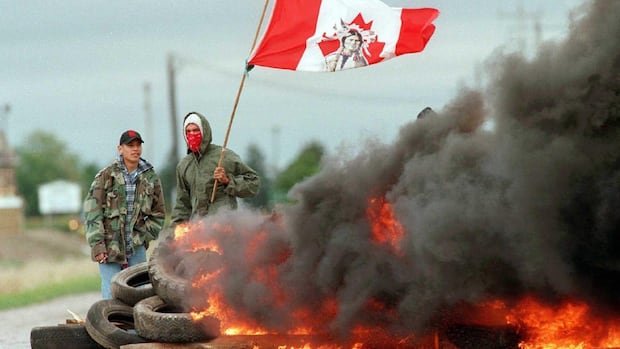

A man claiming to be “Rocky Robart,” an investigator with Canada’s spy agency in Windsor, alleged that the Anishinaabeg at Ipperwash were armed. During a public inquiry in May 2006 regarding the fatal shooting of unarmed protester Dudley George by the Ontario Provincial Police in 1995, Staff Sgt. Wade Lacroix recounted a peculiar visit from the Canadian Security Intelligence Service that summer.
The individual informed Lacroix about the presence of weapons at Camp Ipperwash, located on the southeastern shore of Lake Huron. The area was previously the Stoney Point reserve, expropriated by the federal government in 1942 under the War Measures Act. Members of the Chippewas of Kettle and Stony Point First Nation had been occupying the military ranges since 1993 and took over the barracks in July 1995.
Several witnesses at the inquiry mentioned CSIS’s involvement in the 1995 events, although the agency was not mentioned in Justice Sidney Linden’s final report. Recently declassified documents obtained by CBC Indigenous confirmed that CSIS was conducting a secret nationwide investigation into “Native extremism” in 1995, including active surveillance at Ipperwash before George’s death.
The documents revealed that CSIS labeled the conflict at Ipperwash as an instance of “Native extremists” adopting tactics of armed standoff similar to the Mohawk Warrior Society. However, subsequent investigations showed that the activists were not armed, contradicting the information circulated by CSIS.
Chief Kimberly Bressette of the Chippewas of Kettle and Stony Point First Nation expressed dismay at the misrepresentation of their community by CSIS, emphasizing the strength and resilience of their people. The Stoney Point residents had long awaited the return of their territory promised after World War II.
The tragic events at Ipperwash on September 6, 1995, unfolded during a misguided raid where George was fatally shot by OPP sniper Kenneth Deane. The subsequent inquiry concluded that the activists were unarmed. George was remembered as a caring individual devoted to his family and land.
CSIS’s involvement and misinformation during the Ipperwash conflict have raised questions about the agency’s actions. Layton Elijah, a peacekeeper from the Oneida Nation, shared his encounter with an undercover operative at Ipperwash, shedding light on the covert operations taking place.
Despite CSIS’s refusal to confirm or deny the existence of certain records, the agency’s role in the events leading to George’s death remains a subject of scrutiny. The unfinished business at Ipperwash continues to demand transparency and accountability for the affected communities, striving for justice and healing.