


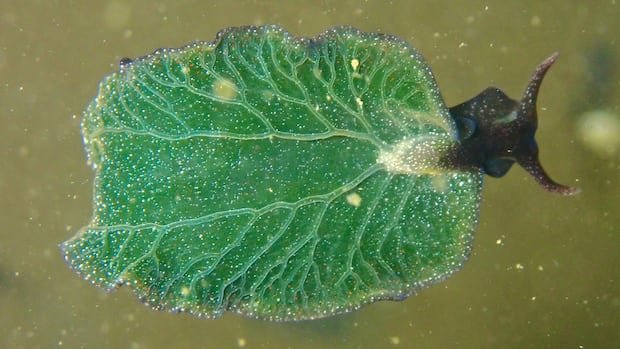

A snorkeler’s chance encounter with a mysterious creature has sparked excitement among enthusiasts and researchers alike. Elli Ofthenorth stumbled upon what she initially thought was a mere leaf but turned out to be a living sea slug, identified as Elysia chlorotica, in Rainbow Haven Provincial Park near Dartmouth, N.S.
Elysia chlorotica, also known as the Eastern emerald elysia, resembles a typical slug until it unfurls an emerald green “leaf” on its back, a unique feature that sets it apart. This leaf enables the sea slug to photosynthesize by retaining chloroplasts from the algae it consumes, allowing it to harness energy from sunlight and survive for extended periods without food.
Researchers are fascinated by E. chlorotica’s exceptional ability to photosynthesize, a rare trait in the animal kingdom. While other sea slugs can also photosynthesize, none do it as effectively as E. chlorotica, making it a standout in the field. Scientists are eager to unlock the secrets behind this process, as it holds potential applications in various fields, including medicine, energy, and biotechnology.
Despite its promising attributes, E. chlorotica remains elusive and difficult to study in detail. While sightings have been reported in Nova Scotia, Martha’s Vineyard, and other locations, the species’ populations are transient, experiencing fluctuations in abundance. The sea slug’s specific habitat requirements, sensitivity to environmental changes, and selective feeding habits contribute to its challenging nature for researchers to observe and maintain in controlled settings.
The recent discovery of a thriving E. chlorotica population within a provincial park highlights the importance of protected areas in preserving biodiversity. Citizen science, as demonstrated by Ofthenorth’s discovery, plays a crucial role in uncovering significant findings and raising awareness about the unique marine life present in our oceans.
As interest in E. chlorotica grows, researchers hope to delve deeper into its biological mechanisms and potential benefits for human applications. The sea slug’s remarkable adaptation to its environment and its symbiotic relationship with algae offer valuable insights that could lead to advancements in various scientific fields.