


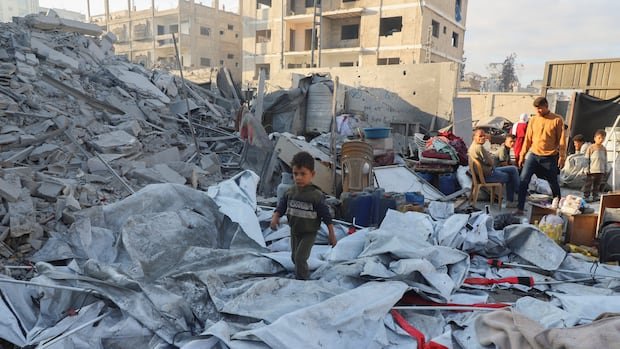

The Israeli military announced on Wednesday its commitment to the ceasefire in Gaza, following clashes that resulted in 104 fatalities as reported by health officials in the region. Both sides have accused each other of violating the agreement. Despite the ceasefire, the military conducted an airstrike in the north of Gaza, targeting an area in Beit Lahia where alleged weapon storage facilities were located, resulting in the death of two individuals.
According to the Gaza Health Ministry, the victims of the Israeli airstrikes included 46 children and 20 women since Tuesday. The recent killing of an Israeli soldier in Gaza led to heightened tensions, marking the most severe escalation since the ceasefire began on October 10.
Israel attributed the soldier’s death to an attack by gunmen within the agreed “yellow line,” from which its troops had withdrawn following the truce. In contrast, Hamas denied responsibility, affirming its commitment to the ceasefire deal. Israel emphasized its adherence to the ceasefire while asserting a firm response to any violations.
In Nuseirat, a central Gaza refugee camp, a tragic incident unfolded as an entire family perished in an overnight airstrike that demolished their home. Witnessing the devastation, a neighbor lamented the loss of about nine lives from the Abu Dalal family, including children and spouses.
Another resident, Hamada Subaih, shared his harrowing experience of narrowly escaping an airstrike that claimed the life of his father while seeking shelter in a northern Gaza school. Expressing profound grief, he highlighted the irreplaceable loss and the futility of the ongoing conflict.
Despite the ongoing violence, U.S. President Donald Trump assured that the U.S.-backed ceasefire remained secure, emphasizing the need for proportional responses to provocations. However, displaced Palestinians expressed concerns over the fragility of the truce, recounting a night fraught with explosions that evoked traumatic memories of past conflicts.
The ceasefire agreement, initiated on October 10 to end the tumultuous period following the Oct. 7 attacks, involved the release of hostages by Hamas in exchange for Palestinian prisoners and detainees held by Israel. The accord aimed to halt hostilities that had claimed numerous lives, with casualties estimated by Israeli figures at around 68,000 civilians.
Amidst the ceasefire implementation, disputes arose over the return of human remains, with Hamas committing to locating and delivering all deceased hostages. Israel accused Hamas of manipulating the recovery process by allegedly staging the retrieval of remains to create a false impression of compliance. The issue of human remains has emerged as a critical challenge in maintaining the ceasefire, closely monitored by international stakeholders.
The International Court of Justice’s ruling demanding Israel to allow UN aid into Gaza underscores the complex humanitarian situation in the region. As tensions persist, efforts to uphold the ceasefire face continual scrutiny and challenges, with the fate of the agreement hanging in the balance.