


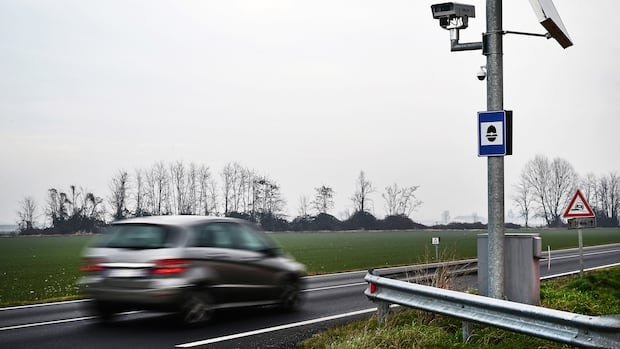

On a cold day in 2024, residents in a suburban area near Padua, Italy woke up to a surprising sight: a speed camera vandalized with an angle grinder, displaying the message “Fleximan is coming.”
Following numerous imitations of speed camera attacks, the name Fleximan has gained a legendary status in Italy. Tom Roper, an English school proprietor residing in the region for 15 years, mentioned, “He was seen as a local hero, with people asking me if I knew Fleximan.”
Despite the flamboyance of Fleximan’s unauthorized activities, there is a widespread agreement across Europe that speed cameras are effective and widely supported.
Jenny Carson, a project manager at the European Transport Safety Council (ETSC) in Brussels, Belgium, stated, “Public backing for enforcement is high when citizens are asked. People desire reduced speeds.”
Italy, hosting over 10,000 operational speed cameras, the highest in Europe, serves as evidence of this inclination. A 2018 European survey revealed that nearly 70% of Italians favored stricter speeding regulations, even though almost half admitted to speeding in the past month.
Amid Ontario Premier Doug Ford’s opposition to speed cameras, labeling them a “cash grab” and contemplating a ban on the technology, it raises the question of how Europe achieved such extensive support for automated enforcement, potentially saving numerous lives annually.
In 2002, following a series of notable traffic accidents, French President Jacques Chirac vowed to prioritize reducing traffic fatalities as a central government policy. Presently, France operates over 2,400 cameras.
Laurent Carnis, a traffic safety expert at France’s Université Gustave Eiffel, indicated that France provides a lesson for Canada: establishing broad support for a comparable system necessitates endorsement at the highest levels.
According to Carnis, political commitment played a pivotal role in building the centralized mechanisms essential for fining drivers nationwide and beyond in France.
Similar to other European nations, France viewed speed cameras not just as enforcement tools but also as educational instruments. They utilized fixed cameras, clearly marked in advance, to educate drivers about automated enforcement, and mobile cameras to penalize speed violators attempting to circumvent the system.
This dual approach of prevention and punishment, known as deterrence theory, has proven effective. Such systems in Europe have led to a significant reduction in average speeds by more than 10 km/h and a decline in road accidents by 20 to 70%.
The positive outcomes in Canada, where municipalities have observed average speed reductions exceeding 20 km/h near speed cameras, mirror these results. Nevertheless, experts caution about the downsides of immediate impact, as the elimination of severe speeding offenses could lead to opposition from certain individuals.
In France, an increasing backlash against speed cameras, resulting in the destruction of up to 75% of the network by vigilantes, highlights the challenge of sustaining public support. This trend is likened to a vaccination scenario, where diminishing impact might lead some to question the program’s necessity.
Experts recommend that governments be discerning and transparent in targeting specific speed offenders with cameras to maintain public support. By focusing on extreme speed violations, authorities can garner more backing for automated enforcement measures.
Critics in Canada argue that speed limits should be rational before enforcing them with speed cameras. Studies have shown that road design elements in Canada, such as wide lanes and ample shoulders, inadvertently encourage higher speeds. Additionally, evolving car safety features may give drivers a false sense of security, prompting them to exceed speed limits.
Despite these considerations, opposition to speed cameras persists. In Italy, where roads are congested, and speed cameras are easily identifiable on GPS, the actions of vigilante Fleximan have prompted Deputy Premier Matteo Salvini to criticize the existing system.
This signals a potential decline in political support for speed cameras in Europe, emphasizing that the widespread backing may be wavering among politicians.
Tom Roper, the school owner in Italy, while admitting to receiving speed camera tickets, remains supportive of the technology as a means to regulate reckless driving. He emphasized the need to control the chaotic driving habits prevalent in the region.