


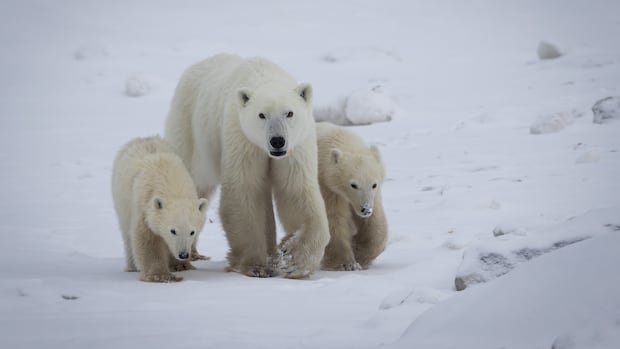

In northeastern Manitoba, scientists conducting research on polar bears were surprised when they encountered a polar bear mother and her cub, along with an additional cub that was not her own. This rare case of cub adoption within the western Hudson Bay subpopulation is only the 13th documented instance. Alysa McCall, a staff scientist at Polar Bears International, expressed a mix of emotions upon confirming the adoption, highlighting the remarkable nature of polar bears and their capacity for altruism.
Evan Richardson, a polar bear research scientist with Environment and Climate Change Canada, recalled an earlier sighting in March when the mother bear only had one cub. Upon revisiting the area in November, the researchers were astonished to find the family had grown to include a third cub, with two of the bears wearing GPS tracking collars. Richardson speculated that the mother’s strong maternal instinct likely drove her to adopt the lone cub she encountered.
The mother bear is estimated to be around five years old, while the cubs are approximately 10-11 months old. Polar bear cubs typically remain with their mothers for up to two and a half years, learning crucial survival skills during this period. The successful adoption provides the lone cub with a higher chance of reaching adulthood, offering hope for its future.
While the reason for the biological mother’s absence remains unknown, Richardson hopes that genetic data obtained from the adopted cub will shed light on its origins. The collaborative efforts of Environment and Climate Change Canada, Polar Bears International, and the University of Alberta’s polar bear science program play a vital role in monitoring and studying polar bears through GPS collars, aiding conservation efforts.
The rarity of cub adoption among polar bears underscores the importance of supporting these iconic creatures, especially in the face of challenges like climate change. Richardson emphasized the positive impact of such adoptions on the bear population in Churchill, emphasizing the significance of these unique occurrences in the wild.