


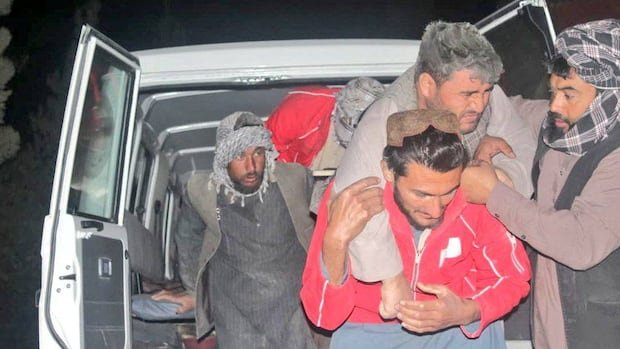

A powerful 6.3-magnitude earthquake struck near Mazar-e Sharif in northern Afghanistan early Monday, resulting in at least 20 fatalities, hundreds of injuries, and significant damage to the historic Blue Mosque. The U.S. Geological Survey reported that the quake occurred at a depth of 28 kilometers close to Mazar-e Sharif, a city with a population of around 523,000.
Survivor Mohammad Rahim, from the Tashqurghan district near the epicenter, described the intense shaking lasting about 15 seconds. He recalled the chaotic scene of dust filling the air, obstructing visibility. Fortunately, his trapped mother and brother were rescued by a joint effort of rescue teams and locals.
Preliminary figures from the Afghanistan National Disaster Management Authority indicated that 20 individuals lost their lives, while 643 sustained injuries, including 25 in critical condition. The Health Ministry spokesperson, Sharfat Zaman, confirmed that rescue and medical teams were deployed to the region, with nearby hospitals on standby to treat the wounded.
The United Nations mission in Afghanistan and India pledged their support for the rescue operations. The earthquake also caused damage to the Blue Mosque, a sacred site in Mazar-e Sharif believed to be the burial place of Prophet Mohammad’s cousin and son-in-law.
The disaster poses additional challenges for Afghanistan’s Taliban government, already facing crises such as a recent earthquake, reduced foreign aid, and mass deportations of Afghan refugees by neighboring nations. The quake disrupted power supply nationwide, affecting Kabul as well, according to Da Afghanistan Breshna Company.
Save the Children expressed concern about the earthquake exacerbating the country’s humanitarian crisis, especially as winter approaches, bringing freezing temperatures. Afghanistan’s susceptibility to earthquakes due to its location on active fault lines has made it prone to such natural disasters, with past events causing substantial casualties and destruction.
Overall, the earthquake in Afghanistan has triggered a significant humanitarian response, with efforts underway to address the immediate needs of the affected communities and mitigate further risks posed by the natural calamity.