


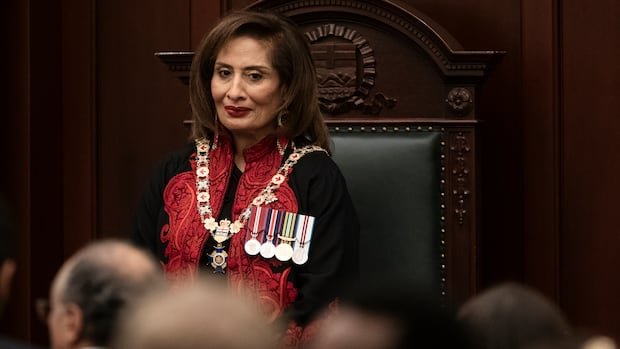

Alberta’s government, as stated in the speech from the throne by Lt.-Gov. Salma Lakhani, aims to eliminate the restriction on oilsands development by collaborating with partners to construct pipelines to the northwest coast of British Columbia and Ontario. The provincial government’s agenda, as outlined in the speech marking the commencement of a new legislative session, emphasizes the successful efforts to emphasize the significance of selling Alberta’s natural resources to the rest of Canada. The government reaffirms its commitment to doubling oil and gas production within an unspecified timeframe. Diplomatic approaches to address U.S. tariff threats are acknowledged as effective in the speech.
The speech highlights Alberta’s ongoing sovereignty efforts, stressing that sovereignty does not equate to separation. A key focus is on reaching a “grand bargain” with the federal government to restore economic autonomy. Following a Liberal victory in the federal election in April, sentiments favoring separation emerged among some Albertans, leading to discussions and a citizen petition that could potentially trigger a referendum on Alberta’s status within Canada.
Premier Danielle Smith introduced the International Agreements Act, the government’s initial bill of the session. The act clarifies Alberta’s role in international agreements, ensuring that such agreements are only enforceable in the province if implemented under provincial legislation. The bill, inspired by a Quebec law from 25 years ago, expands existing Alberta legislation on international trade and investment agreements to encompass all international agreements within Alberta’s jurisdiction or shared national-provincial jurisdiction.
Another upcoming bill will mandate the return of approximately 51,000 teachers to work, ending a province-wide strike and lockout that has disrupted classes in public, Catholic, and francophone schools. The speech also addresses the decline in oil and gas royalty revenues, resulting in a deficit for the province this year. Plans to enhance the value of the Heritage Fund and promote economic diversification are outlined to reduce dependency on such revenues in the future.
Regarding immigration control, the government plans to introduce a bill to modify Alberta driver’s licenses and identification cards by adding a marker for Canadian citizens. The speech reaffirms existing commitments, including initiatives to enhance public services, health care, and affordability, alongside developing a passenger rail system, hiring more police officers, reorganizing health care bodies, and modernizing school infrastructure over a seven-year period.
Opposition leaders have criticized the throne speech, claiming it overlooks critical issues affecting Albertans and prioritizes political interests over the province’s welfare. The introduction of Bill 1 is viewed as a potential distraction from pressing concerns and could face constitutional challenges if enacted into law. Independent MLA Pete Guthrie has expressed concerns that Bill 1 may prioritize political motivations over the province’s needs.