


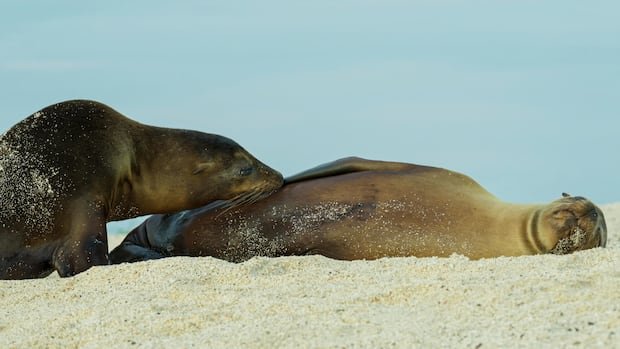

A recent study led by Alexandra Childs, a PhD candidate in behavioural and marine biology at Germany’s University of Bielefeld, has shed light on the intriguing behavior of fully grown Galápagos Islands sea lions that continue to nurse from their mothers well into adulthood. The study, published in the American Naturalist journal, revealed that approximately 11% of the sea lion population exhibited this behavior, which researchers have dubbed “supersuckling.”
Unlike most sea lions that wean off their mothers between 1.5 and 4.5 years of age, these “supersucklers” persist in nursing beyond the expected threshold. Childs mentioned that observing sea lions in their teens and even up to 16 years old nursing was akin to humans breastfeeding into their 60s.
The study, spanning 20 years of data on Galápagos sea lions (scientifically known as Zalophus wollebaeki), highlighted the unique phenomenon of supersuckling, which involves multiple generations of sea lions engaging in prolonged nursing. While similar behaviors have been observed in other sea lion and seal species, the prevalence and extent of supersuckling in the Galápagos stood out.
Experts like Andrew Trites from the University of British Columbia’s Marine Mammal Research Unit noted that this behavior is typically linked to food scarcity, with mothers ensuring their offspring receive the necessary energy for growth and survival. However, the study pointed out that supersuckling was more common during periods of ample food resources rather than scarcity.
Childs suggested that supersuckling could serve as a bonding behavior or have immunological benefits, but further research is needed to confirm these hypotheses. The study cautioned against drawing definitive conclusions solely based on weather patterns, emphasizing the complexity of factors influencing food availability and feeding behaviors in sea lion populations.
As researchers continue to unravel the mysteries behind this unique behavior, Childs expressed hope for future studies to delve deeper into the social and biological aspects driving supersuckling among Galápagos sea lions.