


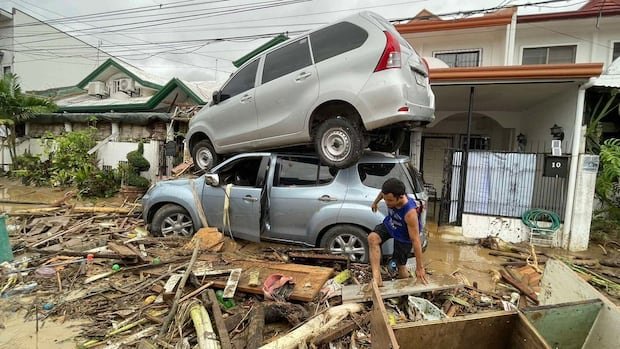

A powerful typhoon named Kalmaegi has resulted in the loss of 26 lives in the Philippines, predominantly due to flooding triggered by the storm’s passage through the central region of the country on Tuesday, according to disaster response authorities. The flooding left numerous individuals stranded on rooftops and submerged vehicles.
Additionally, six individuals lost their lives when a Philippine Air Force helicopter crashed in a separate incident while delivering humanitarian aid to regions affected by Kalmaegi in southern Agusan del Sur province. The bodies of all individuals aboard the helicopter were recovered following a search operation near Loreto town, as confirmed by the military’s Eastern Mindanao Command.
As of its last known location over the coastal waters of Jordan town in Guimaras province, Kalmaegi boasted sustained winds of 130 km/h with gusts reaching up to 180 km/h. The typhoon was expected to move towards the South China Sea after impacting Palawan province.
Deputy administrator Bernardo Rafaelito Alejandro IV of the Office of Civil Defence reported that at least 26 fatalities were recorded, with many occurring due to flooding in Cebu province and other central island areas hit by Kalmaegi. The specific details of the casualties caused by the typhoon are still under verification.
In Southern Leyte, an elderly resident drowned in floodwaters, leading to a province-wide power outage following the typhoon’s landfall in the region. Tragically, a resident in central Bohol province lost their life after being struck by a falling tree during the storm.
Gwendolyn Pang, the secretary general of the Philippine Red Cross, mentioned that an unknown number of individuals were stranded on roofs in Liloan, Cebu, due to rising floodwaters. She highlighted the challenging rescue efforts amidst the debris and submerged cars in affected communities.
In Eastern Samar, where Kalmaegi initially struck, strong winds tore off roofs and damaged approximately 300 mostly rural dwellings. Fortunately, there were no reported casualties as a result of the storm in this region.
The Philippines, known for its vulnerability to natural disasters, faces around 20 typhoons annually along with seismic activities and volcanic eruptions. The country’s resilience is continually tested by such calamities, with communities striving to recover and rebuild in the aftermath of each catastrophe.