


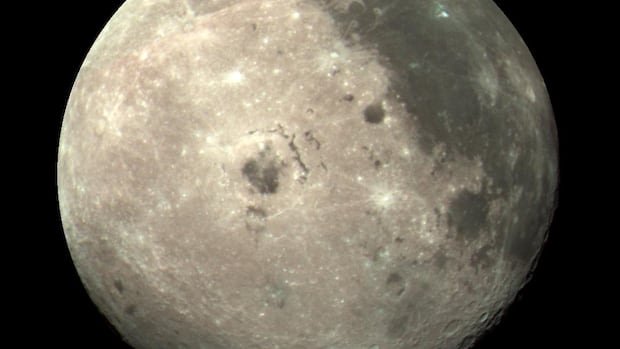

When Jeremy Hansen, the Canadian astronaut, embarks on the Artemis 2 mission beyond the moon, part of his duties will involve observing the moon’s far side, which remains unseen from Earth. Concurrently, scientists on Earth will also monitor these observations, as they plan to deploy telescopes and robots to explore deep space from the far side of the moon.
The moon exhibits a dual nature, being gravitationally locked to Earth, with one side always facing our planet while the other side looks out into deep space. Despite being commonly referred to as the “dark side,” the far side receives as much sunlight as the Earth-facing side.
Contrary to the near side’s large flat plains known as “Maria,” the far side of the moon features a rugged, crater-filled surface. It offers a tranquil environment shielded from Earth’s artificial radio noise, making it an appealing location for astronomers to set up radio telescopes.
Access to the far side of the moon is only possible through spacecraft, granting Hansen a rare opportunity to witness sights seldom seen by humans since the Apollo era. Unlike early astronauts who orbited close to the surface and only observed equatorial regions, Hansen’s Artemis trajectory will take him 7,500 kilometers beyond the moon, providing a panoramic view of the entire globe. Moreover, he will witness the Earth and moon together, a unique perspective never before seen by human eyes.
Throughout the Artemis mission’s lunar flyby, the crew will make detailed visual observations of the lunar surface from the windows. The human eye can discern subtle details such as color variations or shades of grey that cameras might overlook, indicating ground conditions critical for potential spacecraft landings.
One of the proposed missions to the far side involves the Japanese TSUKUYOMI, or Lunar Meter Wave Telescope, aiming to establish an array of radio dishes on the lunar far side. This endeavor seeks to delve into the universe’s earliest days during the “dark ages” period, approximately 400,000 years after the big bang, characterized by a predominance of neutral hydrogen gas emitting faint radio signals detectable by sensitive instruments on the moon.
These signals from the dark age could unravel the mysteries surrounding dark matter’s influence on the early universe’s evolution, potentially guiding the formation of stars, galaxies, and planets. Future plans include deploying additional antennae and observatories, such as LuSEE Night and Farside Seismic Suite, on the moon’s far side to further advance scientific understanding.
While human missions to the moon prioritize creating a colony and exploring for water ice at the south pole, landing sites will always maintain Earth on the horizon for communication purposes. Meanwhile, on the hidden side of the moon, a multitude of robots will silently gaze towards the universe’s edge and the origins of time, seeking answers to the universe’s beginnings.