


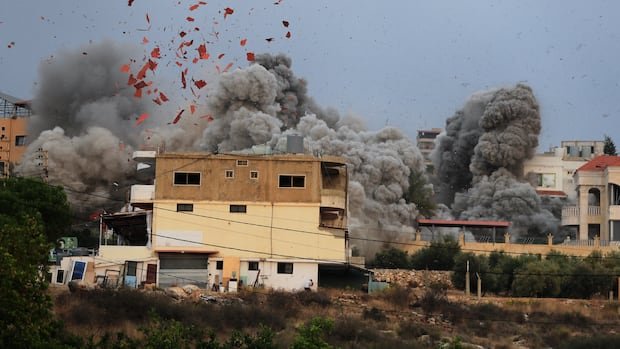

Israeli warplanes conducted airstrikes on multiple towns in southern Lebanon on Thursday, marking a significant increase in their almost daily attacks on the nation. Despite a ceasefire established in November 2024, the airstrikes occurred shortly after Hezbollah advised the Lebanese government against engaging in negotiations with Israel.
Residents in Tayba, Tayr Debba, and Aita al-Jabal received warnings from Israeli spokesperson Avichay Adraee to evacuate 500 meters from the targeted residential buildings, which were allegedly utilized by Hezbollah. Subsequently, warnings were issued for Zawtar al-Sharqiyah and Kfar Dounin.
Lebanon’s civil defense facilitated the evacuation of individuals from the affected areas, as reported by the Lebanese state news agency. While most residents evacuated before the strikes, Lebanon’s health ministry confirmed one injury. Earlier strikes on Thursday resulted in one fatality, according to the ministry.
The Israeli military stated that they targeted Hezbollah’s military infrastructure in those regions, including “weapons storage facilities… established within civilian-populated zones.” They accused the militant group of reestablishing its capabilities nearly a year after the U.S.-brokered ceasefire agreement came into effect.
Hezbollah has refrained from attacking Israel since the ceasefire pact was enacted last year. The strikes on Thursday led to the destruction of an ironworks business in Abbasiyeh, southern Lebanon.
Lebanon has witnessed over 270 fatalities and approximately 850 injuries due to Israeli military operations following the ceasefire, as per Lebanon’s health ministry. The U.N. human rights office confirmed that 107 of the deceased were civilians or noncombatants by October 9, voiced spokesperson Thameen Al-Kheetan.
Israeli government spokesperson Shosh Bedrosian emphasized Israel’s commitment to defending its borders and enforcing the ceasefire agreement with Lebanon during a press briefing on Thursday.
The Lebanese Prime Minister Nawaf Salam and his administration convened in Beirut to review a plan developed by the Lebanese military to disarm Hezbollah and other non-state armed groups. Following the meeting, Information Minister Paul Morcos noted the cabinet’s support for the military’s progress despite ongoing challenges, notably Israeli hostilities.
Lebanese President Joseph Aoun criticized Israel’s strikes and military presence on five hilltop locations within Lebanese territory. Aoun instructed the army to counter any Israeli encroachment into southern Lebanon following an incident where Israeli forces crossed the border and killed a municipal employee.
Aoun expressed willingness to engage in negotiations with Israel to ease tensions, a move opposed by Hezbollah. The militant group, also involved in politics, asserted its right to resist Israeli occupation and pledged support to the Lebanese army.
Hezbollah clarified that while Lebanon adhered to the ceasefire, it was not obliged to partake in political talks with Israel. The group’s military capabilities suffered significant damage during Israel’s extensive air campaign in 2024, but Hezbollah leader Sheikh Naim Qassem affirmed their readiness to combat regardless of limited resources.
The Lebanese army aimed to eliminate all unauthorized arms in southern Lebanon by year-end, with senior security officials indicating progress in disarmament efforts. The U.S. Treasury announced fresh sanctions targeting financial operatives supervising fund transfers from Iran to Hezbollah, focusing on entities enabling money laundering activities.
Both sides accused each other of breaching the ceasefire that formally concluded the recent Israel-Hezbollah conflict in November. The conflict stemmed from a Hamas-led attack on Israel on October 7, 2023, which escalated into a full-scale war by September 2024 amid rocket exchanges between Hezbollah and Israel.