


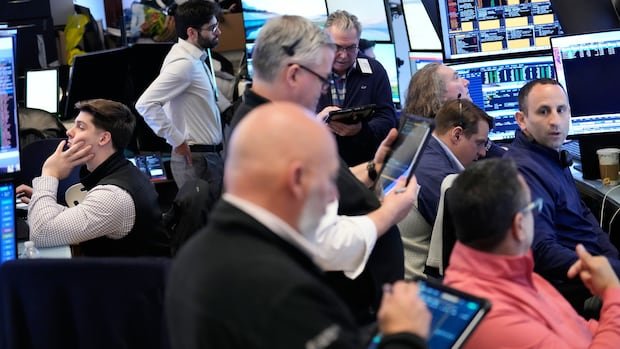

Stocks took a sharp decline on Thursday, with oil prices increasing, amid escalating uncertainty on Wall Street regarding the potential resolution of the U.S.-Israeli conflict with Iran. The S&P 500 recorded a significant 1.7% drop, marking its most substantial decline since January and signaling a fifth consecutive week of losses. This losing streak, which predates the war’s onset on February 28, is poised to become the lengthiest in nearly four years.
Furthermore, the Dow Jones Industrial Average plummeted by 469 points, equating to a 1% decrease, while the Nasdaq composite experienced a 2.4% decline, falling more than 10% below its previous all-time peak earlier this year. This dip is commonly referred to as a “correction” by investment professionals.
Global stock markets mirrored this downward trend, with declines observed across Asia and Europe. The financial markets exhibited a series of fluctuations throughout the week, commencing with optimism following U.S. President Donald Trump’s announcement of constructive discussions aimed at resolving the conflict. However, Iran refuted claims of direct negotiations and dismissed a U.S. proposal for a ceasefire relayed through Pakistan.
Despite ongoing talks, the conflict persisted, with an influx of additional U.S. troops nearing the region while Iran tightened its control over the vital Strait of Hormuz. The strait’s strategic significance was underscored by Iran’s potential establishment of a “toll booth” for tankers transiting the narrow waterway, which typically facilitates the transportation of a significant portion of the world’s oil from the Persian Gulf to global markets.
In response to the escalating tensions, the price of Brent crude oil surged by 4.8% to settle at $101.89 US, reflecting diminished hopes for a swift resolution at the strait. This marked a substantial increase from the pre-war price of approximately $70. Similarly, benchmark U.S. crude witnessed a 4.6% rise, reaching $94.48 per barrel.
Amidst the geopolitical developments, President Trump initially issued stern warnings to Iran on social media, emphasizing the need for prompt action. However, he later adopted a more conciliatory tone, postponing his threat to target Iranian power facilities to April 6 to allow for extended negotiation periods.
Consequently, oil prices experienced a slight retraction, with Brent crude edging back towards $100 per barrel. Concurrently, Treasury yields moderated their earlier surges in the bond market.
The fluctuating bond market and heightened Treasury yields were key considerations for President Trump, who faced criticism for backing down from his initial tariff threats during previous geopolitical events. Notably, the yield on the 10-year Treasury surged to 4.43% on Thursday, a significant increase from pre-war levels, impacting various lending rates within the U.S. economy.
Meanwhile, tech stocks emerged as prominent casualties on Wall Street, with Meta Platforms and Alphabet witnessing notable declines following legal repercussions related to social media addiction. The broader market also saw significant declines, with the S&P 500 closing at 6,477.16, the Dow Jones Industrial Average at 45,960.11, and the Nasdaq composite at 21,408.08.
Internationally, Germany’s DAX, Hong Kong’s Hang Seng, and South Korea’s Kospi all experienced declines, underscoring the global impact of the geopolitical tensions on financial markets. Japan’s Nikkei 225, however, registered a comparatively modest loss of 0.3%.
The evolving situation continues to weigh heavily on global markets, with investors closely monitoring developments amidst ongoing geopolitical uncertainties.