


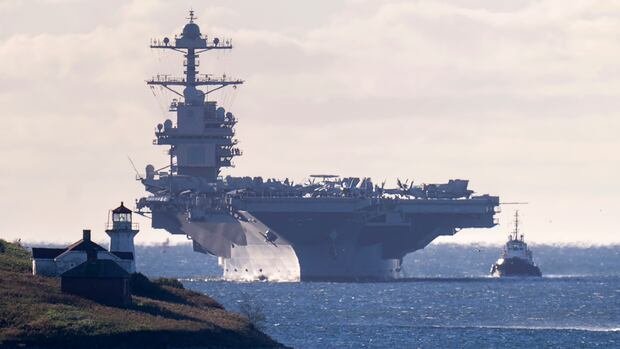

President Trump mentioned on Sunday that the U.S. could engage in talks with Venezuelan President Nicolas Maduro, hinting at a potential diplomatic dialogue amidst the escalation of American military activity near Venezuela with the deployment of its most advanced aircraft carrier.
Although Trump did not provide specifics about the potential discussions with Maduro, he acknowledged that “Venezuela would like to talk.” The recent arrival of the USS Gerald R. Ford and other warships, as announced by the Navy, is viewed as a significant development in what the administration describes as a counterdrug operation but is perceived by some as a tactic to exert pressure on Maduro.
Trump’s comments on Maduro’s willingness to engage in talks were met with ambiguity, with Trump stating, “What does it mean? You tell me, I don’t know.” He added that he is open to dialogue with anyone and will observe the outcome of such interactions.
Maduro, who is facing accusations of narcoterrorism in the U.S., has dismissed the notion of a fabricated war being orchestrated against him by the U.S. government.
The deployment of the Ford marks the culmination of a substantial increase in U.S. military presence in the region, involving nearly a dozen Navy ships and around 12,000 sailors and Marines.
The U.S. military’s recent strike on a small boat suspected of carrying illegal drugs coincided with the carrier’s arrival. The Southern Command of the military shared a video showing the boat being destroyed, claiming the incident occurred in international waters and resulted in the deaths of three individuals. The military is yet to provide further details on the operation.
The carrier strike group, equipped with fighter jets and guided-missile destroyers, passed through the Anegada Passage near the British Virgin Islands, according to the Navy. Adm. Alvin Holsey emphasized the readiness of American forces to combat transnational threats aimed at destabilizing the region.
In Trinidad and Tobago, which lies in close proximity to Venezuela, joint military exercises with the U.S. have begun, focusing on addressing violent crime in the region. The exercises have been characterized as a second iteration within a month and are part of efforts to combat drug trafficking routes passing through the island nation.
The U.S. has maintained that its military buildup aims to disrupt drug flows into the country, with Trump suggesting potential further actions beyond sea strikes to prevent drug smuggling over land.
Senator Marco Rubio declared the U.S.’s intention to designate the Cartel de los Soles as a foreign terrorist organization, attributing its leadership to Maduro and other high-ranking officials. Rubio accused the cartel of engaging in terrorist activities and drug trafficking within the hemisphere.
The international community has raised concerns about the U.S. military’s actions, with France’s foreign minister criticizing the boat strikes as violations of international law. Canada, previously reserved on the matter, acknowledged the U.S.’s authority in making decisions on such operations.
The unfolding situation involving the U.S., Venezuela, and other regional players continues to draw international attention and scrutiny.