


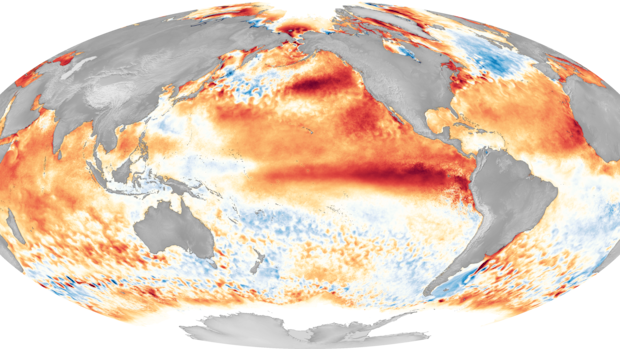

A potential “super” El Niño is being discussed, which could lead to increased global temperatures and more severe weather patterns in the upcoming months. Several climate models are indicating a strong El Niño expected to start in June or July and peak in November, with ocean temperatures in a key Pacific region possibly rising by 2 degrees Celsius above average, with some models suggesting even higher anomalies.
El Niño is part of the El Niño-Southern Oscillation (ENSO) system, impacting weather worldwide. When a specific region in the Pacific Ocean, known as Niño 3.4, experiences warmer temperatures, an El Niño event occurs. The U.S. National Oceanic and Atmospheric Administration (NOAA) has mentioned an 82% chance of El Niño development between May and July and a 96% chance of continuation from December to February, although the peak strength remains uncertain.
Under normal circumstances, trade winds move warm water from South America to Asia in the Pacific Ocean. However, during El Niño, these winds weaken, causing a reversal in the ocean current dynamics. While a strong or potential ‘super’ El Niño might occur this year, its effects in Canada are not expected during the summer but will have global implications.
The impact of El Niño in Canada is usually felt during the winter months, with warmer winters recorded in the eastern and central regions. The last El Niño event resulted in Canada’s warmest winter on record, with a temperature anomaly of 1.5 degrees Celsius, and the forecast for the upcoming event is projected to be even higher.
Climate change exacerbates the warming trend, with the past 11 years being the warmest on record. El Niño, combined with ongoing global warming, is likely to lead to a record-breaking year in 2027. Climate scientists emphasize that addressing climate change is crucial, as its effects are more substantial than those of El Niño. Extreme weather events are becoming more frequent due to climate change, with recent heat waves and wildfires being attributed to this phenomenon.
While El Niño could result in extreme conditions later this year, the primary concern remains climate change and its long-term impact on global weather patterns. The potential for increased wildfire risk in Western Canada due to El Niño further highlights the urgency of addressing climate change to mitigate its severe consequences.