


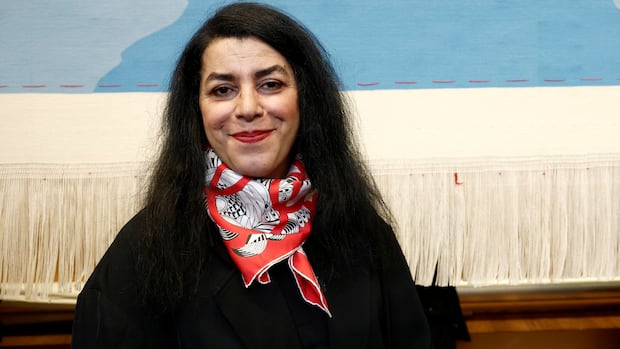

Renowned Iranian-French cartoonist and filmmaker Marjane Satrapi, a well-known supporter of women’s rights, has passed away at the age of 56, as confirmed by the French presidency on Thursday.
“Her departure signifies the loss of a significant figure in French culture and an artist committed to liberty, whose works conveyed a universal message and garnered her considerable global recognition,” the presidency stated in an announcement.
President Emmanuel Macron and his wife expressed their respect for “an extraordinary artist who turned her Iranian childhood into a universal narrative,” according to the statement.
According to reports from news outlet BFM TV and other French media, Satrapi “died of sadness” just over a year following the death of her husband, Swedish film producer and actor Mattias Ripa, as stated by acquaintances of the artist.
In a statement on social media, the French Academy of Fine Arts, of which she was a member, conveyed its heartfelt sorrow, honoring “a fervent advocate for cinema and film education,” who earlier this year established a foundation to assist international students in coming to Paris to pursue film studies.

Refused French honor in protest
Satrapi is widely recognized for her black-and-white autobiographical graphic novel and film Persepolis, which narrates a coming-of-age story against the backdrop of the Islamic Revolution in her homeland, Iran.
Persepolis received the Film Critics Grand Prix at the Cannes Festival in 2007 and the Cesar Award for best adapted screenplay in 2008, in addition to a nomination for best animated feature at the 2008 Oscars.

Actors Anna Kendrick and Ryan Reynolds, and director Marjane Satrapi, left to right, were at the Toronto International Film Festival on Sept. 11, 2014, for a showing of the film The Voices. (Leonard Adam/Getty Images.)
The film, which chronicles her experiences in Tehran as the spirited daughter of intellectual Marxists, serves as a reminder that Iranians share commonalities with people everywhere, Satrapi remarked to The Associated Press in a 2007 Cannes interview.
“What we aimed to convey is, if these individuals intimidate you, look closer: They have families, they have partners, they have aspirations, they have stories,” she said.
At the time, Iranian authorities expressed their opposition to the film’s participation at Cannes by sending a letter to the French Embassy in Tehran.
Her graphic novels also feature works like Broderies and Poulet aux prunes, the latter of which was adapted into a film she directed featuring French actor Mathieu Amalric. Additionally, she directed Radioactive, a biographical film about Polish physicist Marie Curie, portrayed by Rosamund Pike, and The Voices, a dark comedy/thriller with a cast that included Ryan Reynolds, Anna Kendrick, and Gemma Atherton.
In 2023, Satrapi collaborated on the book Femme, vie, liberte with various artists and scholars to depict the protests that erupted in Iran following the death of Mahsa Amini in 2022 at the hands of the so-called morality police. This work condemns the oppression and violation of human rights faced by Iranian society, particularly women, as highlighted by the foundation.
In 2024, Satrapi was presented with France’s highest honor, the Legion of Honor, which she declined, arguing that France was insufficiently supporting Iranians striving for democracy.
“Supporting the women’s revolution in Iran cannot merely be limited to photographs or speeches,” she stated in a January 2025 letter to French officials. “When individuals are battling for democracy, we must stand by them.”
Born on November 22, 1969, in Rasht, Iran, Satrapi’s parents sent her to Vienna in 1983 to complete her education due to the extremism following the 1979 Revolution that brought Ayatollah Khomeini to power.
However, finding Austria unwelcoming and longing for her parents, Satrapi returned to Iran in 1989 to enroll at Tehran University, where she obtained a degree in visual communications.
By the time she graduated, Satrapi felt ready to leave Iran and embrace the opportunities her parents had desperately sought to provide for her a decade earlier. In 1994, she relocated to France, where she studied in Strasbourg before eventually moving to Paris.