


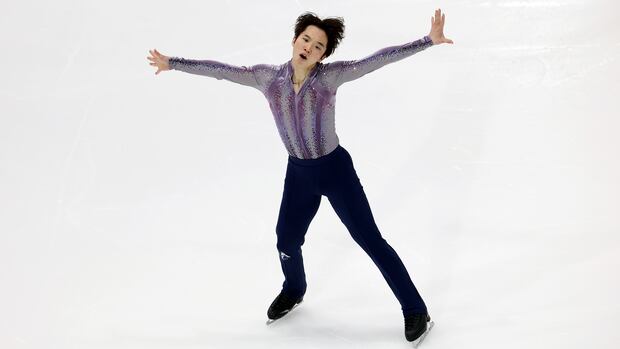

Japanese figure skater Kazuki Tomono showcased his most impressive short program in over three years as Skate America commenced on Friday night, placing him ahead of France’s Kevin Aymoz and Kazakhstan’s Mikhail Shaidorov before the free skate event.
In his first Grand Prix competition of the season, Jason Brown from the U.S. secured fifth place, trailing Italy’s Daniel Grassl.
During the pairs event, Anastasiia Metelkina and Luka Berulava continued their ascent in the global rankings with an almost flawless routine set to the classic “Bolero,” which allowed them to establish a substantial lead over Riku Miura and Ryuichi Kihara.
The 27-year-old Tomono, who is vying for one of Japan’s spots at the Winter Olympics in February, delivered a strong performance, starting with a quad toe-triple toe combination and continuing through a quad salchow and a triple axel. By the conclusion of his short program, accompanied by music from the New York-based duo SOFI TUKKER, the audience in Lake Placid, New York, erupted in applause with a standing ovation.
His score of 95.77 not only marked a season high but also represented Tomono’s best short program score since the world championships in 2022.
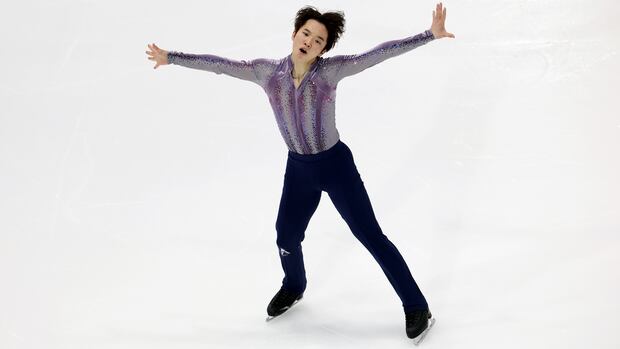
Kazuki Tomono of Japan leads the men’s competition at Skate America after scoring 95.77 in the short program.
Aymoz, a six-time French champion, achieved a score of 93.56 following a strong comeback from a disappointing performance at Skate Canada, which had left him emotional. Despite nursing a left foot injury, he executed an opening quad toe-triple toe, followed by a solid triple axel and a triple lutz to complete his short program.
Shaidorov, who was the last skater to perform, is still in pursuit of his inaugural Grand Prix victory after earning bronze at the Cup of China earlier this season. The 21-year-old world silver medalist faces a challenge in Lake Placid, as his component scores lowered a program that included two quad jumps, resulting in a score of 89.67.
Grassl finished in fourth place with a score of 83.68, while Brown secured 82.69, despite a routine that consisted solely of triple jumps.
The 30-year-old American is striving to qualify for his third Olympic team for the Milan Cortina Games and is participating in consecutive Grand Prix events—this one followed by the Grand Prix of Finland next weekend. Although this is an unusual approach for a top competitor, Brown hopes it will enhance his performance leading into the national championships in January and potentially the Olympics.
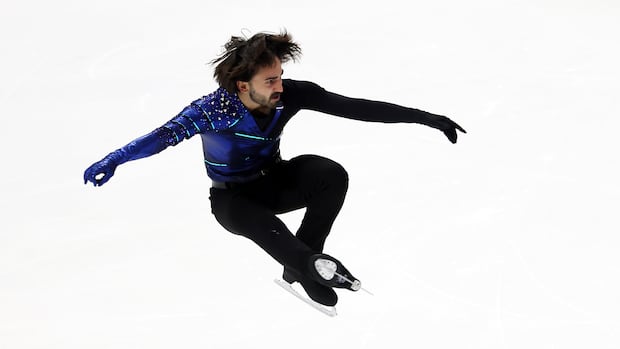
Watch the men’s short program at Skate America, an ISU Grand Prix of Figure Skating stop in Lake Placid, N.Y.
Brown had a lot to refine during a revamped version of his renowned “Riverdance.” He under-rotated his initial triple axel and stumbled on a triple lutz-triple toe combination, impacting his total score. However, the quick and precise footwork, characteristic of both “Riverdance” and Brown’s skating style, enabled him to finish among the top five.
“It’s incredibly special,” Brown mentioned, as he embraced young skaters who gathered the stuffed animals tossed onto the ice. “This is my first opportunity to perform this program in front of a home crowd. All my emotions came rushing back.”
A decade has passed since Brown made his Grand Prix debut at Skate America.
“You experience the nerves,” he added. “You feel the thrill.”

CBC Sports’ Anastasia Bucsis chats with American figure Jason Brown and he shares some of the trials and tribulations of being known as the “Riverdance” guy. Plus he breaks down some of the adversity he has faced being a figure skater and competing.
Metelkina and Berulava, the pair from Georgia with Russian roots, followed their triumph at the Cup of China by achieving a season-best score of 78.83. Their performance was highlighted by synchronized side-by-side triple salchows and a throw triple twist.
“We’re very pleased today. We skated really well. Clean,” Berulava expressed. “Step by step.”
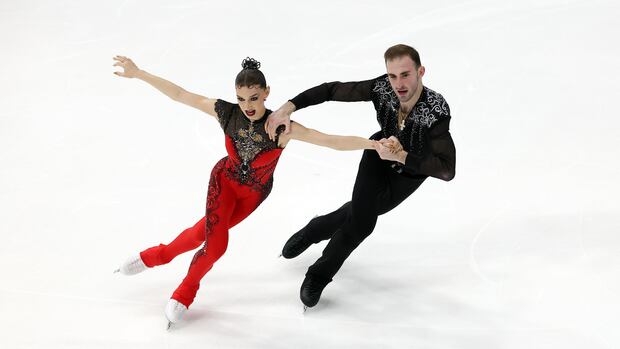
Anastasiia Metelkina and Luka Berulava of Georgia are in first place at Skate America after scoring 78.83 in the short program.
Miura and Kihara, the two-time reigning world champions from Japan, encountered difficulties with their side-by-side jumps, as she failed to execute the planned triple toe loop, which proved to be a critical error. They ended with a score of 74.42 points.
Germany’s Annika Hocke and Robert Kunkel claimed third place with 68.26 points. The U.S. duo of Emily Chan and Spencer Howe finished fifth, while Canada’s Kelly Ann Laurin and Loucas Ethier placed sixth.
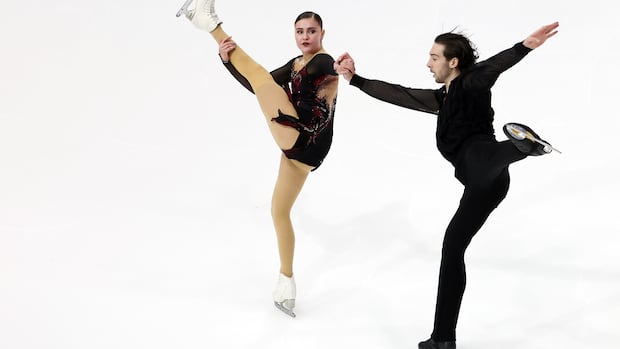
Kelly Ann Laurin of St-Jérôme, Que., and Loucas Éthier of St-Alphonse, Que., are in sixth place after a season-best score of 61.29 in the short program at Skate America.
The medals for both the men’s and pairs categories will be determined on Saturday night, along with the commencement of the ice dance competition and the women’s short program. The final day of Skate America on Sunday will conclude the medal awards.