


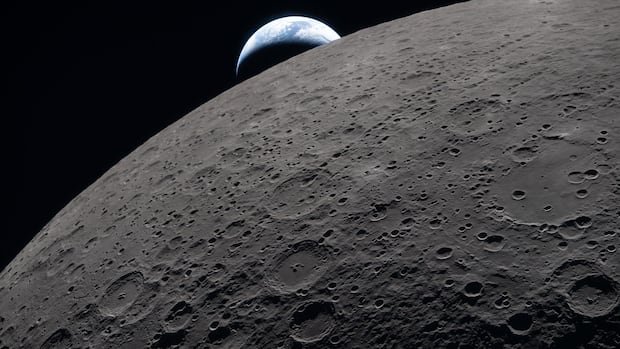

The Artemis II mission crew, including Canadian Space Agency astronaut Jeremy Hansen and NASA astronauts Reid Wiseman, Victor Glover, and Christina Koch, are returning after witnessing the moon in an unprecedented way. During the mission, the astronauts traveled farther from Earth than any humans have before, providing a unique opportunity to observe the moon’s far side directly.
While satellites have captured images of the moon’s far side since 1959, this mission marked the first time humans could see certain regions with their own eyes. NASA’s Artemis II lunar science lead, Kelsey Young, expressed excitement about the prospect of having humans witness and describe lunar features firsthand. The astronauts utilized cameras and their naked eyes to make observations during the five-hour flyby, providing detailed descriptions of what they saw.
Particular attention was given to the Orientale basin, a region spanning the moon’s near and far sides, believed to have formed 3.8 billion years ago. Astronaut Hansen noted color variations in the region, pointing out brownish and greenish hues. The human eye, more sensitive than a camera, can discern subtle color and brightness differences without the need for enhanced saturation.
Moreover, the astronauts observed meteoroids striking the moon’s surface, a phenomenon rarely witnessed on Earth due to the lack of atmosphere on the moon. The crew reported seeing impact flashes, highlighting the advantage of human observation in capturing transient events that cameras may miss.
While cameras play a crucial role in moon observations, visual observations by astronauts offer unique insights into lunar features. NASA’s chief exploration scientist, Jacob Bleacher, emphasized the significance of combining visual and camera observations to enhance our understanding of the moon. The detailed accounts provided by the Artemis II crew during the flyby are now being complemented by higher resolution images, enriching the scientific findings of the mission.