


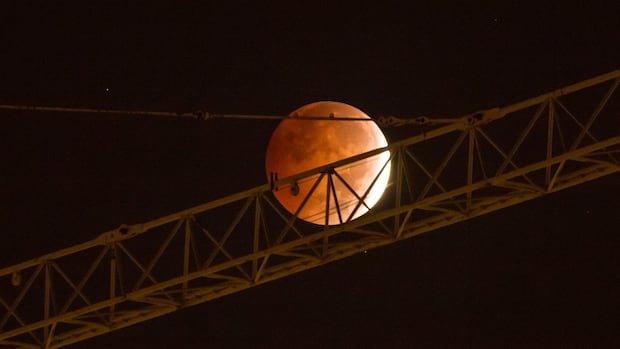

In the early hours of Tuesday, a total lunar eclipse will be visible across Canada as the moon passes through Earth’s shadow. The visibility of the eclipse varies depending on the location. Western Canada, including B.C. and Yukon, will witness the entire eclipse, while the Prairie provinces will miss out as the moon sets in the western sky. Parts of Atlantic Canada will only see a partial eclipse.
To catch a glimpse of the eclipse, observers will need to rise early or stay up late, as the event occurs in the early morning hours. Unlike solar eclipses, lunar eclipses unfold over several hours with distinct phases. Initially, the moon passes through the penumbra, Earth’s faint outer shadow, where no significant brightness change is noticeable. Subsequently, the moon enters the umbra, Earth’s inner, darker shadow, leading to a partial phase where part of the moon may appear dim or disappear.
During a total lunar eclipse, the moon fully enters the umbra but does not vanish; instead, it often adopts a reddish or orange hue due to Earth blocking direct sunlight. This phenomenon is commonly referred to as a “blood moon.” The moon’s color during the eclipse is a result of sunlight filtering through Earth’s atmosphere, with shorter wavelengths like blue scattering more easily and longer wavelengths like red passing through.
The eclipse’s appearance can be influenced by atmospheric conditions, such as high dust levels after events like volcanic eruptions. The eclipse is set to begin at 3:44 a.m. ET/12:44 PT when the moon enters the penumbra, with little change in appearance. The umbra phase, where the top left part of the moon darkens, commences at 4:50 a.m. ET/1:50 a.m. PT. Totality starts at 6:04 a.m. ET/3:04 a.m. PT and ends at 7:03 a.m. ET/4:03 a.m. PT before transitioning back to a partial eclipse.
While the moon will have set for those in the eastern time zone, viewers in Alberta, Saskatchewan, and Manitoba will experience the entire totality phase. It is recommended to check specific eclipse timings for each location on TimeandDate for accurate viewing information. Paul Delaney, an emeritus professor of physics and astronomy at York University, advises eclipse viewers to dress warmly for the chilly weather and plan photography shots considering the moon’s position relative to the surroundings.