


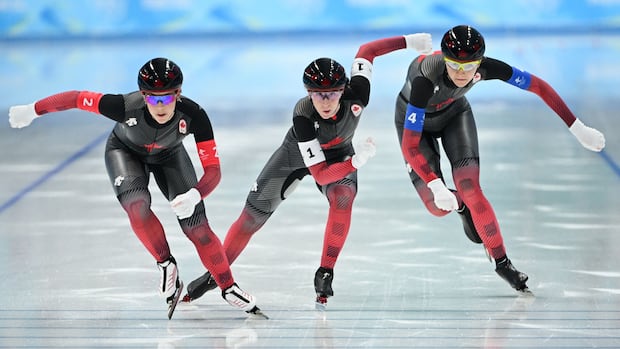

Since speed skaters Ivanie Blondin, Valérie Maltais, and Isabelle Weidemann claimed team pursuit gold at Beijing 2022, competitors worldwide have been striving to close the gap.
As the next Winter Olympics approach, Canada’s reigning Olympic champions understand that they cannot afford to become complacent.
Blondin, Maltais, and Weidemann have made their way to Salt Lake City for the inaugural World Cup event of the long track season, though this edition is abbreviated due to the upcoming Milano-Cortina 2026 in February.
The trio arrived at the Utah Olympic Oval a few days ahead of their fellow Canadian teammates to participate in a training camp focused on team pursuit, aiming to reunite and prepare. Maltais mentioned that they are there to develop a new approach that they hope will once again lead them to the top of the podium.
Prior to this season, they have skated together on two occasions leading up to the 2025-26 season, but this time is distinct. It marks the first instance they have dedicated a camp solely to the discipline in which they won Olympic gold nearly four years ago. Since that victory, their rivals have improved and adapted their race strategies.
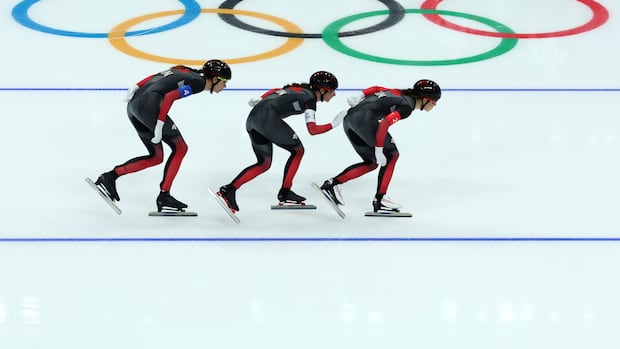
CBC Analyst Kristina Groves breaks down the team pursuit in long track speed skating, which sees three athletes competing together to push each other to the fastest time.
In the women’s team pursuit, two teams of three skaters start simultaneously from opposite sides of the 400-metre oval, completing a total of six laps. Skaters frequently alternate leading, with others closely following to benefit from reduced wind resistance, and the clock stops only when all three skaters have crossed the finish line.
When Blondin, Maltais, and Weidemann first collaborated at the 2019 world championships, they achieved an unexpected fourth-place finish despite one of the members lacking experience in the discipline and the race tactics that they still ponder today.
“It was my first team pursuit ever, and we finished fourth. We were making countless exchanges,” Maltais recalled. “I can’t even remember exactly what we did. Like, I couldn’t contribute much…”
“I don’t think any of us could contribute much,” Weidemann added with a laugh.
“No, I genuinely don’t remember; our strategy was chaotic,” Maltais stated. “It evolved and changed, and this year, it’s going to be a new approach.”
Blondin remarked that that race demonstrated their new partnership had the potential to flourish.
“We were incredibly excited because it was our first competition together, finishing fourth at worlds, and we were very close to the podium. We felt, ‘this is something we can build on,’” Blondin expressed.
While speed skating is inherently an individual sport, the team pursuit demands that athletes collaborate, employing precise strategies. With races often decided by fractions of a second, even a slight time advantage can be crucial in determining the winner.
Each of the three skaters shines individually as well. Weidemann, 30, earned silver in the 5,000m and bronze in the 3,000m at Beijing. Blondin, 35, also secured a mass start silver at those Games and holds silver medals in the mass start from the last two world championships. Maltais, also 35, began her career in short track and has a 2014 world championship bronze in the 1,000m. She is the reigning national champion in the 3,000m.
Following their debut in 2019, the trio concentrated on developing team pursuit tactics that would best utilize their individual strengths.
“We really went back to the drawing board, asking ourselves, ‘what can we improve?’” Blondin recounted. “The strategy we believed would yield the fastest results was having Val take the lead for the first lap and a half, after which I would take over for the next lap and a half. This would lead us to three laps, and then Izzy would complete the final three laps with Val and me pushing from behind.
“That was our winning formula at the time.”
They applied that strategy to secure a spot at the top of the podium in Beijing 2022, where they set an Olympic record in the final against Japan. Weidemann often reflects on that moment, as it has established the benchmark for all future performances.
“I believe that moment has truly defined our team up to this point,” Weidemann stated. “We have more chapters to write, but it’s a moment we think about frequently and the standard we aspire to achieve again.”
After their success in Beijing, the trio utilized that effective strategy to earn a world championship title in 2023. However, it appeared that other teams began to catch up. The Netherlands secured gold at the 2024 worlds, leaving the Canadians with silver, and last season saw them drop to bronze, finishing behind both the Dutch and Japanese teams.
“Following the Beijing Games, there was a shift among teams experimenting with maintaining one skater in the lead while the other two skaters pushed for the entirety of the race,” Blondin explained. “With exchanges, you actually end up losing… 0.2 [seconds] with each switch.”
Blondin noted that this new strategy benefited teams capable of maintaining high lap times throughout the race, allowing for faster finishes.
“We were a bit slow to adapt because of our previous success, which led us to be hesitant in changing our strategy… we were still performing well. Consequently, we stuck with our existing approach,” she said.
“Eventually, the other teams gradually started catching up to us – they were closing the gap, and we began to lose races here and there. That’s when we realized, ‘Okay, we need to make a change.’”
The Canadian skaters may be altering their tactics in hopes of discovering the extra edge required to reclaim their spot on the Olympic podium, but their goals remain unchanged.
“I believe our aim is to achieve some impressive times while skating together to demonstrate that we are a team to contend with and perhaps challenge ourselves to explore uncharted territory,” Weidemann said. “All of us are eager to discover how fast we can go as a team.
“I don’t think we’ve ever fully realized our potential, and that’s the goal this year – to see if we can uncover that.”
Maltais anticipates that the team will strive for a podium finish at Milano-Cortina, but she does not feel that their performance at the previous Games imposes any additional pressure or expectations beyond what they already set for themselves.
“Defending a title means arriving at the line fully prepared to compete and seeing what we can achieve at our best,” Maltais stated. “Regardless of whether it’s gold, silver, or bronze, at the end of the day, defending that title means delivering our best performance.”
The strategy off the ice will also remain consistent for the Canadians, who believe that maintaining strong connections is vital to their success – an aspect that also requires practice and commitment.
“I think it’s crucial to connect with each other outside the oval,” Weidemann noted. “For us, grabbing coffee after practice is significant. Engaging in conversations that don’t revolve around speed skating and checking in on one another are important. We are three unique individuals with different backgrounds.”
“As Val said, to reach the starting line and maximize our potential, we need to support one another. We’ve worked hard to ensure we are all aligned in that regard.”
“I believe effective communication is also essential,” Blondin added. “We are continuously learning, and it’s an ongoing journey.
“It’s never been perfect, but we are all committed to making progress.”
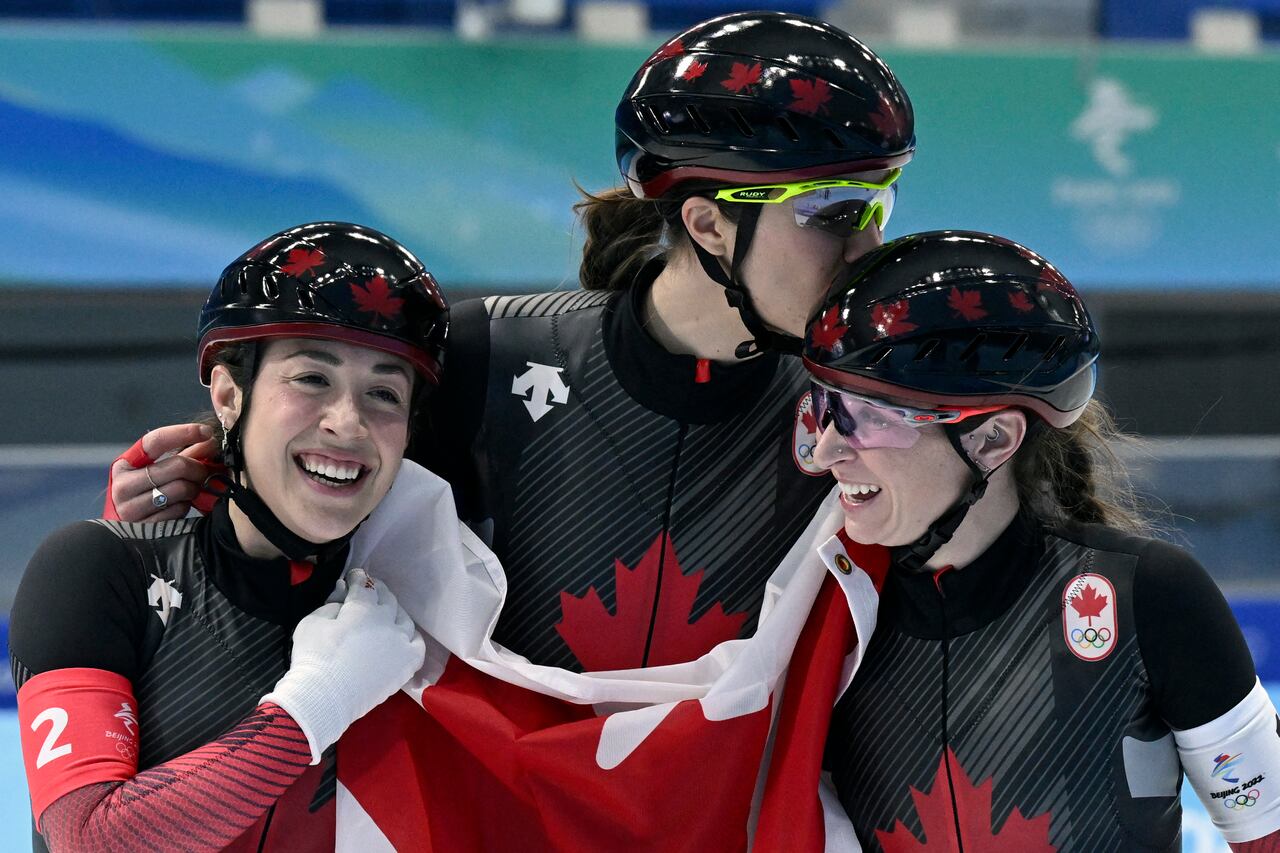
Maltais, Weidemann, and Blondin are shown in this file photo celebrating after they won Olympic gold in the team pursuit final in Beijing on Feb. 15, 2022. (File/AFP via Getty Images)
CBC Sports will live stream all the action from the World Cup speed skating season opener at the Utah Olympic Oval beginning on Friday at 6 p.m. ET. Coverage continues on Saturday (2:30 p.m. ET) and on Sunday (3 p.m. ET), which also features the team pursuit events.
For full information on when and how to watch speed skating events this season, visit the CBC Sports broadcast schedule by clicking here.