


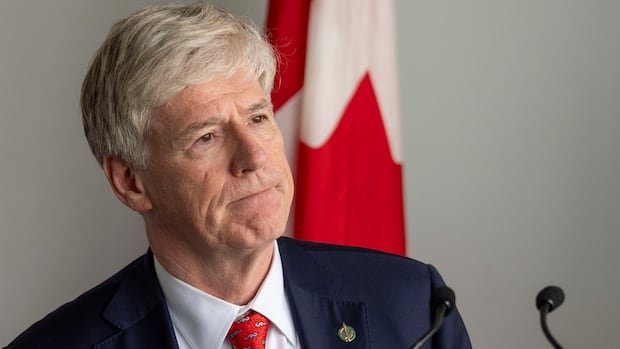

Ahead of the upcoming announcement of Prime Minister Mark Carney’s climate competitiveness plan, Energy Minister Tim Hodgson provided insights into what will be included in the budget set for release on Tuesday. Hodgson discussed three key approaches guiding the government’s efforts without directly mentioning the climate strategy.
He highlighted the strategic use of public funding and tax incentives to reduce risks and encourage investments in innovative projects. The aim is to ensure the competitiveness of the Canadian economy and products in a low-carbon global market. Hodgson specifically mentioned the potential for government funding to support and expand Canada’s carbon capture, storage, and removal sector.
Additionally, Hodgson emphasized the importance of creating a regulatory environment that offers certainty to industries through consistent policies, streamlined processes, and reliable permitting. The government is already working on implementing laws to expedite major resource projects.
Furthermore, Hodgson highlighted the use of artificial intelligence to enhance energy systems, making them more efficient and resilient. He noted that AI technology is transforming energy production, distribution, and consumption by enabling real-time grid demand predictions and optimizing renewable energy sources like wind farms.
Regarding the proposed emissions cap for industrial sectors, Hodgson did not address its future in his remarks. The article mentions the one-year anniversary of the government’s draft regulations to impose emission limits on the oil and gas industry, which is a significant contributor to Canada’s emissions.
An expert in climate policy, Louise Comeau, suggested that the government may prioritize investment in carbon capture and storage over implementing the emissions cap. She explained that while carbon capture technology is still unproven at a large scale, it could help industries like cement, steel, and oil and gas reduce emissions while maintaining or increasing production levels.
Hodgson also highlighted various initiatives led by the Canadian government to promote low-carbon power generation, including nuclear plant extensions, small modular reactors, natural gas with carbon capture and storage, and grid-scale battery storage solutions.
Overall, there are concerns raised by the Canadian Climate Institute and government projections indicating that Canada may not meet its 2030 climate targets. Despite recent policy changes by the Carney administration, such as cancelling the consumer carbon price and pausing the electric vehicle availability standard, there is a need for additional measures to achieve emission reduction goals.
The information provided by Minister Hodgson offers a glimpse into the government’s approach to addressing climate competitiveness and transitioning to a low-carbon economy.