


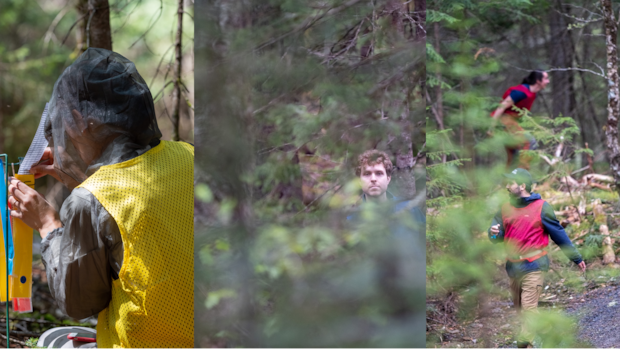

Skulking cautiously through Quebec’s forests, experiencing a rush of adrenaline while navigating scarce resources and evading predators is part of Université Laval ecologist David Bolduc’s daily routine. To delve deeper into the intricate dynamics between predators and prey in nature, Bolduc and a team of international students gathered at Éco-Laurentides park near Val-Morin, Que., for a predator-prey simulation game.
The game involved participants divided into three groups: prey, mesopredators, and apex predators. The prey focused on gathering resources, connecting with their team, and avoiding predators, while the predators aimed to capture prey. The study, detailed in the open-source journal Methods in Ecology and Evolution, revealed that humans exhibit similar survival strategies to wildlife species like wolves and deer.
Although the experiment was praised as an innovative approach to studying ecosystems, scientists cautioned about its limitations in translating human game dynamics to real-life animal behaviors where the stakes are life-threatening. The simulated game aimed to mimic predator-prey interactions realistically, offering a practical alternative to controlled mathematical models and challenging fieldwork scenarios.
By manipulating variables like landscape and resource distribution while maintaining a consistent player group, researchers could explore different predator-prey scenarios. However, the findings from the game would require validation through observations of actual animals in their natural habitats to draw conclusive insights.
The study highlighted that while humans in the game mirrored some behaviors observed in wild animals, significant differences exist due to individual player biases, competitiveness, and the absence of real-life risks like death. Despite these distinctions, the game served as an effective educational tool, sparking engaging discussions on ecological theory and animal behavior among participants.
The researchers emphasized that the game provided a fresh and enjoyable perspective on ecological theory, fostering a deeper understanding of these concepts in a dynamic and interactive manner.