


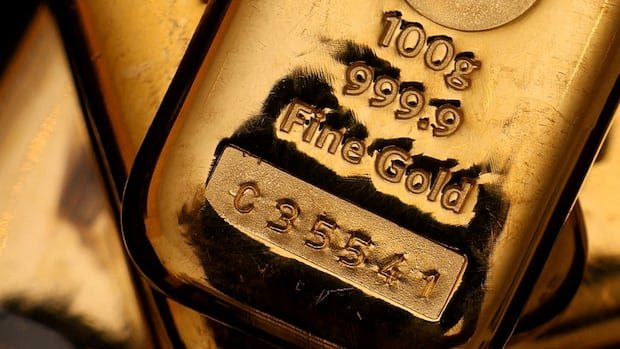

Wild fluctuations in financial markets subsided as Wall Street commenced trading on Monday. U.S. stocks remained relatively stable after gains in Europe and significant declines in Asia. Gold and silver prices rebounded from earlier sharp losses.
The focal point in financial markets once again was precious metals, with momentum coming to a sudden halt after gold’s price had nearly doubled over the past year. Gold briefly dipped below $4,500 US per ounce during overnight trading, marking a decline of over $1,000 from its recent peak. However, it later recovered much of the loss, settling at $4,725.00, reflecting a 0.5% decrease from Friday’s levels.
Silver experienced even more volatile movements, swinging from a nine percent overnight loss to a three percent gain. The surge in gold and silver prices had initially been driven by investors seeking secure assets amidst various concerns, such as potential changes in Federal Reserve independence, high valuations in the U.S. stock market, tariff threats, and global government debt burdens.
On Friday, both gold and silver prices plummeted, with silver witnessing a sharp 31.4% drop. Some analysts attributed this decline to President Donald Trump’s nomination of Kevin Warsh as the next Fed chair, speculating that Warsh might maintain high interest rates to combat inflation, thereby reducing the appeal of gold and silver as safe-haven assets.
However, there is skepticism on Wall Street regarding this interpretation, as some believe that Trump’s expectation is for Warsh to lower interest rates, in line with the President’s demands. The Fed chair’s decisions hold significant sway over the global economy and markets, influencing interest rates and investment prices to maintain economic stability.
The recent price fluctuations in gold and silver are likely attributed to traders unwinding leveraged positions rather than a fundamental shift in demand for these metals. Darrell Cronk, the chief investment officer at Wells Fargo, noted that the decline was more about traders closing out positions that had bet on continued metal price increases.
At the market open, the S&P 500 slightly declined by 0.1%, potentially marking its fourth consecutive loss. The Dow Jones Industrial Average rose by 111 points, or 0.2%, while the Nasdaq composite dipped by 0.3%. Notably, tech stocks, including Nvidia, faced losses, with Nvidia dropping by 2.2% due to concerns about the impact on artificial intelligence technology. In Asia, AI-related stocks experienced significant declines, with South Korea’s Kospi plunging 5.3%, its worst performance in nearly 10 months, following a nearly nine percent drop in chip company SK Hynix’s shares.