


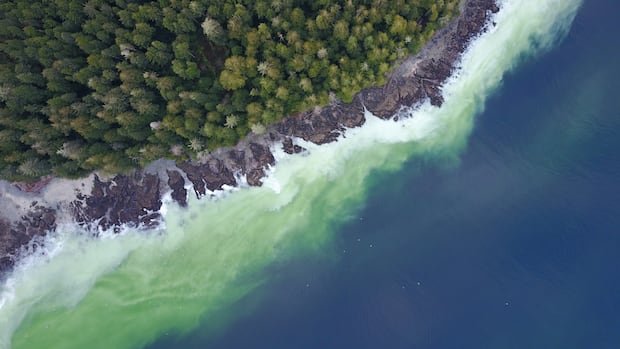

Ryan Cutler, residing near Salmon Beach on Vancouver Island’s west coast, observed foamy ocean waters last week, signaling the commencement of the herring spawn. Cutler described this period as a remarkable spectacle. Utilizing a drone, he captured the distinctive foamy, milky blue-green water indicative of herring gathering for reproduction in the shallow coastal bays.
The herring spawn holds great significance for Vancouver Island and the South Coast communities, symbolizing the arrival of spring and a time for food gathering for coastal First Nations. This event also serves as a critical juncture for marine conservation efforts due to the decline in herring populations attributed to overfishing over recent decades.
Herring, a pivotal species known for aggregating in large numbers for reproduction, have females laying eggs on kelp and eelgrass while males release milt, creating the milky water appearance. Cutler highlighted the unmistakable signs of staging leading up to the spawn, witnessing sea lions gathering, eagles soaring, and humpback whales swimming in the vicinity.
Nick Chowdhury, president of the Island Marine Aquatic Working Group, emphasized the spawn’s importance for coastal First Nations, marking a period for food gathering and a transition in seasons. From a conservation perspective, tracking the spawn’s occurrence aids in evaluating fish stocks and observing potential returns to previously unutilized areas.
Shirley Louie, a seasoned fisher from the Stz’uminus First Nation, recently delved into herring knowledge through a documentary project by the Q’ul-lhanumutsun Aquatic Resources Society. This society, representing six coast Salish First Nations, focuses on aquatic resource management, with Louie learning traditional herring catching and preparation methods, including utilizing a herring rake for fishing.
The Island Marine Aquatic Working Group’s Facebook page facilitates monitoring the spawn’s whereabouts, aiding in stock management and fishing quota advocacy efforts. Louie emphasized the value of reconnecting with traditional foods like herring and reviving cultural practices.