


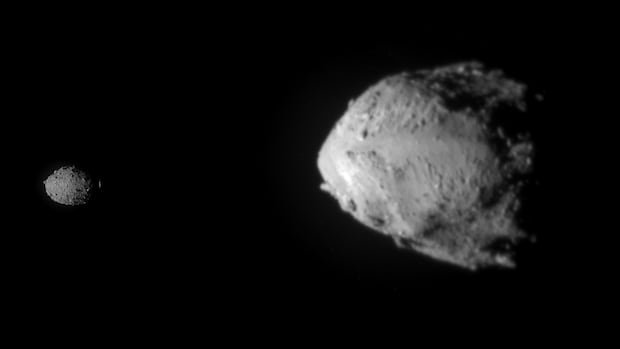

NASA’s recent mission has revealed groundbreaking evidence that asteroids can be redirected. Scientists emphasize the importance of having the capability to deflect potentially hazardous asteroids that may be on a collision course with Earth. These space rocks come in various sizes, leading to impacts with different effects, ranging from small, dazzling fireballs to massive rocks capable of causing global devastation and mass extinction.
In 2022, NASA’s Double Asteroid Redirection Test (DART) spacecraft intentionally collided with the small moon Dimorphos, which orbits the larger asteroid Didymos, after a 10-month journey to the binary asteroid system. The successful mission, conducted approximately 11 million kilometers from Earth, resulted in shortening Dimorphos’s orbit around Didymos by about 32 minutes. Additionally, a recent study published in Science Advances indicates that the collision slightly altered the pair’s trajectory around the sun.
Lead author Rahil Makadia, a planetary defense scientist from the University of Illinois Urbana-Champaign, views these findings as a significant advancement in safeguarding our planet. He emphasizes that instead of destroying asteroids, a minor push well in advance could potentially divert a threatening asteroid away from Earth.
The decision to target a two-asteroid system was deliberate. While some asteroids exist independently, many have small moons or form binary systems where multiple rocky bodies orbit each other in space. Derek Richardson, an emeritus professor of astronomy at the University of Maryland, explains that targeting a binary system allowed for easier measurement of the orbit changes post-collision.
The impact of the spacecraft collision on the asteroid system’s heliocentric orbit was carefully tracked using radar measurements and stellar occultations. The collision resulted in a slowing of the asteroid system’s orbit by 11.7 microns per second, equivalent to about 360 meters per year. This observation marked the first time a heliocentric orbit change was observed.
The implications of the DART mission extend beyond scientific discovery. The data gathered will be crucial for planning future asteroid-deflection missions. The collision with Dimorphos not only reshaped the asteroid but also provided insights into momentum enhancement, effectively doubling the impact delivered by the spacecraft alone.
Overall, these findings offer a promising outlook on Earth’s safety in the face of potential asteroid threats. The technology showcased in the DART mission demonstrates the capability to intervene if a threatening asteroid were to approach, contributing to planetary defense strategies for safeguarding against future impacts.