


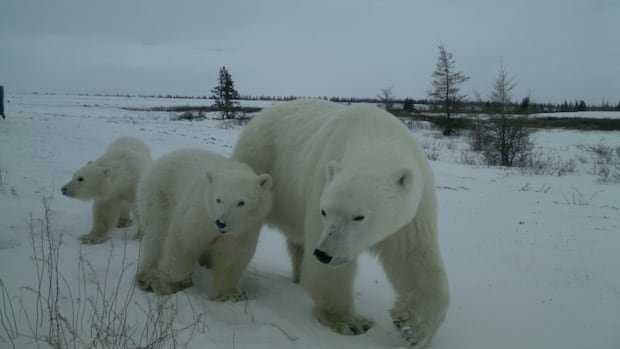

In Canada’s northern regions, residents have noticed a rise in polar bears coming ashore and interacting with people over the years. Initially, it was believed that these bears were hungry and forced onto land due to diminishing sea ice, potentially seeking food from humans. However, a recent 11-year study conducted by researchers at the University of Saskatchewan and University of Manitoba has revealed a different perspective on this phenomenon.
Contrary to popular belief, the research indicates that the increased presence of polar bears on land is not solely due to their hunger or sea ice depletion. Douglas Clark, a professor at the U of S, noted that it was not just undernourished bears approaching communities but bears of various body conditions, ages, and genders. The study, which involved monitoring bears using trail cameras in Wapusk National Park near Churchill, Manitoba, found that the bears’ frequency of encountering humans was primarily linked to their extended periods off the ice.
Parks Canada observed that polar bears were showing interest in new field camps, prompting further investigation into their behavior towards people. Clark, an experienced polar bear scientist, and his team gathered data over 11 years, analyzing over 500 bear visits, sea ice patterns, and human activities. The research, recently published in Arctic Science, indicated that the bears’ interactions with humans were a result of climate change-induced sea ice reduction, pushing them closer to human settlements.
Although some bears were indeed hungry, they did not exhibit predatory behavior towards humans. Clark emphasized that while nutritional stress played a role, it did not drive bears en masse towards communities as previously assumed. The study’s co-researcher, Alex Crawford from the University of Manitoba, highlighted the importance of recognizing that polar bears are not becoming more aggressive towards humans due to food scarcity.
Crawford explained that with declining sea ice, polar bears are spending more time on land, increasing their chances of encountering humans. However, he stressed that the health status of the bears did not correlate with their likelihood of seeking out humans. Starving polar bears remain a significant threat if they come into contact with people, as they may resort to seeking food from humans out of desperation. The ongoing research project aims to monitor polar bears’ behavior in response to long-term changes in their environment and food sources.
The study sheds new light on the interactions between polar bears and humans in the context of climate change and sea ice loss, emphasizing the need for continued monitoring and understanding of these iconic Arctic animals.