


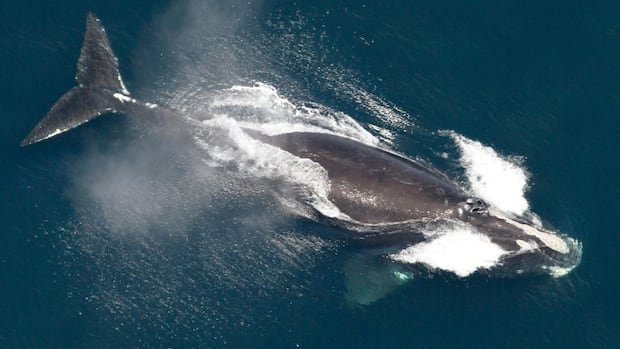

Efforts to safeguard the endangered North Atlantic right whale population have included measures such as reducing ship speeds in whale zones and promoting the use of ropeless fishing gear to prevent entanglements. However, changes in whale congregation locations have posed challenges to these initiatives.
To address this issue, researchers from the University of Maine and the New England Aquarium are collaborating to enhance their modeling techniques for predicting the whales’ whereabouts. Camille Ross, an associate research scientist at the New England Aquarium, emphasized the importance of such models in filling data gaps when direct observations are not feasible due to the vast ocean territory the whales traverse.
The study, titled “Incorporating prey fields into North Atlantic right whale density surface models,” led by Ross, was recently published in Endangered Species Research. According to the U.S. National Marine Fisheries Service, only around 370 North Atlantic right whales remain globally, with approximately 70 reproductive-age females.
Ross highlighted the whales’ adaptation to evolving ocean conditions, necessitating predictive models that can identify new feeding habitats. By tracking zooplankton, particularly calanoid copepods that serve as the whales’ primary food source, the research team utilized past studies and statistical algorithms to create a comprehensive image of prey distribution in the Northwest Atlantic.
The ongoing zooplankton sampling programs provide valuable data for their research, but Ross emphasized the need for continuous improvement and incorporation of new studies to refine their models. She stressed the importance of field observations and data collection to enhance the accuracy of the models, especially with climate shifts impacting the whales’ behavior patterns.
Matt Abbott, Fundy Baykeeper and Marine Program Director at the Conservation Council of New Brunswick, commended the research for its potential to inform decision-makers and collaborative efforts with industries like shipping and fisheries to mitigate impacts on the right whales. Abbott emphasized the critical status of the whale population and the necessity of conservation measures to safeguard these iconic marine mammals.
Abbott noted the decline in right whale sightings in the Bay of Fundy over the past 15 years, attributing it to ecological changes that have led the whales to seek suitable habitats elsewhere. The study’s findings are expected to contribute valuable insights for ongoing conservation efforts aimed at protecting the North Atlantic right whales.
[Source](https://www.cbc.ca/news/canada/new-brunswick/nb-right-whale-food-model-1.7638126)