



Canadian authorities are working to decipher President Donald Trump’s recent social media announcement regarding a 10% increase in what he termed as “the Tariff on Canada.” However, there is a lack of specifics from the U.S. president on this matter. Despite posting on social media about the tariff increase, Trump has not specified which Canadian exports to the U.S. will be affected, nor has his administration formally informed Canada about the tariff hike.
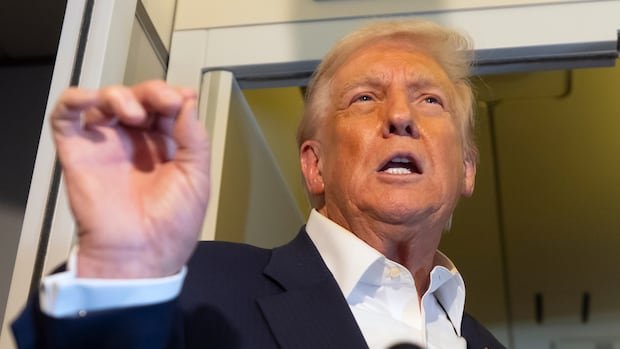
During a press interaction aboard Air Force One on Monday, Trump evaded questions about the timing of the tariff increase, stating, “I don’t know when it’s going to kick in, and we’ll see, but I don’t really want to discuss it.” Trump did discuss an advertisement by the Ontario government that seemingly led to the suspension of trade talks with Canada and the subsequent tariff hike announcement.
Trump continued to assert that the Ontario ad was misleading and distorted former President Ronald Reagan’s stance on tariffs, despite evidence that Reagan was staunchly against tariffs on economic allies like Canada. The U.S. Supreme Court is preparing to hear arguments on November 5 in a case where Trump’s administration is appealing a ruling that deemed his imposition of broad-based tariffs on various countries, including Canada and Mexico, unconstitutional.
When questioned about his decision to increase tariffs on Canada due to a provincial government ad, Trump justified it by stating that Canada was taking advantage of the U.S. economically. He expressed reluctance to meet with Prime Minister Mark Carney at the upcoming Asia-Pacific Economic Cooperation (APEC) summit in South Korea.
The White House indicated that the ad was not the sole reason for the heightened trade tensions with Canada. Senior administration members were in the process of negotiating a potential deal for tariff relief on steel and aluminum imports from Canada when the talks were terminated by Trump. The White House criticized Canadian officials for not engaging effectively with the administration.
Treasury Secretary Scott Bessent labeled the Ontario ad as interference in U.S. matters and propaganda aimed at denouncing the tariffs. However, specifics on which Canadian exports would be subject to the 10% tariff increase were not provided by Bessent when questioned on TV programs. The administration’s frustration with Canadian negotiations was highlighted by Kevin Hassett, the director of Trump’s National Economic Council, who described the Canadians as challenging to negotiate with.