



A significant military assault by the U.S. on a suspected drug trafficking vessel near Venezuela’s coast is just the beginning of a broader operation, as per officials. U.S. Defense Secretary Pete Hegseth has announced that military activities will persist, laying the groundwork for an ongoing military effort in Latin America. Late on Tuesday, U.S. President Donald Trump shared a video showing an aerial strike that obliterated a small boat. Trump claimed the vessel was carrying substantial amounts of drugs and 11 “terrorists,” all of whom perished in the attack. This action follows a military build-up that commenced weeks ago, involving the relocation of warships closer to Venezuela and the deployment of thousands of troops. The military’s objective is to intercept cartels attempting to transport drugs to the U.S.
Trump indicated that the video was meant to serve as a deterrent. He stated, “Obviously they won’t be doing it again and I think a lot of other people won’t be doing it again when they watch that tape.” Trump alleged that the 11 individuals killed were affiliated with the Tren de Aragua gang, although no evidence was provided to support this claim.
Tren de Aragua, a drug cartel that originated as a prison gang in Venezuela’s central state of Aragua over a decade ago, is notorious for its extreme violence, including beheadings and live burials. The group expanded its operations to Chile, Colombia, New York, Chicago, Denver suburbs, and neighboring nations. Authorities attribute various criminal activities such as kidnapping, extortion, sex trafficking, and drug smuggling to its members. Last year, the Biden administration designated Tren de Aragua as a transnational crime organization. Subsequently, in February, Trump classified the group as a “foreign terrorist organization,” a designation typically reserved for political entities like al-Qaeda, not criminal syndicates. Trump accuses the gang of facilitating the influx of violent migrants into the U.S., causing turmoil in cities.
Venezuelan President Nicolás Maduro denies any connections to Tren de Aragua, asserting that the gang was dismantled in 2023 and dismissing it as a fictional creation by the international media. The Venezuelan government alleges that the gang is part of a U.S.-backed plot, along with Venezuela’s opposition, to assassinate Maduro and destabilize the nation. In contrast, the Trump administration labels Maduro as one of the world’s top narco-traffickers, alleging collusion with cartels to inundate the U.S. with fentanyl-laced cocaine. Preceding Trump’s current term, Maduro faced narco-terrorism charges in New York in 2020, resulting in a $15 million US bounty on his arrest, which was later raised to $25 million by the Biden administration. Attorney General Pam Bondi recently doubled the reward to $50 million, announcing the seizure of $700 million in assets linked to Maduro, including two private jets and seven tons of cocaine.
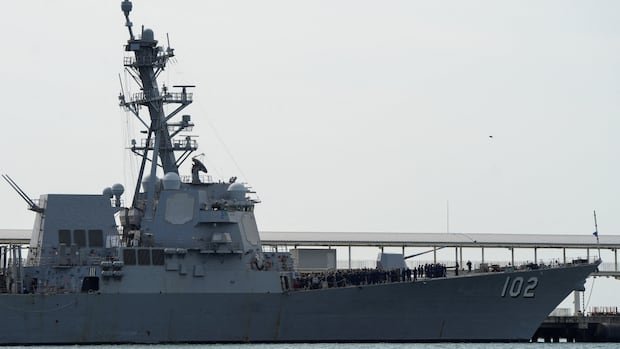
While no imminent invasion signals have been detected, the U.S. has visibly escalated its military presence near Venezuela. Navy destroyers and a cruiser have been deployed closer to the Venezuelan coast, with plans to station three amphibious assault ships capable of carrying over 4,000 soldiers and marines in the region. The extent of the operation remains undisclosed by the military and the Trump administration.
In response to inquiries regarding potential military strikes on Venezuela, press secretary Karoline Leavitt did not rule out the possibility. She emphasized Trump’s commitment to employing all available resources to prevent drug influx into the U.S. and bring the perpetrators to justice.
Maduro recently addressed Venezuelans, urging them to brace for a potential invasion amid heightened military pressure. He denounced the deployment as an unjustifiable and criminal threat, declaring maximum readiness for Venezuela’s defense. Maduro deployed troops along the coast and border with Colombia and called for enlistment in a civilian militia to bolster preparedness. Venezuelan Foreign Minister Yvan Gil demanded an immediate halt to the deployment, condemning it as a baseless menace to national sovereignty.
Maduro’s assertion of winning last year’s presidential election faces staunch opposition, with Canada and the U.S. disputing the legitimacy of his claim. Venezuela’s political opposition seeks international support to oust Maduro from office, with leader Maria Corina Machado endorsing the U.S. military’s involvement, branding Maduro’s government as a criminal enterprise.