


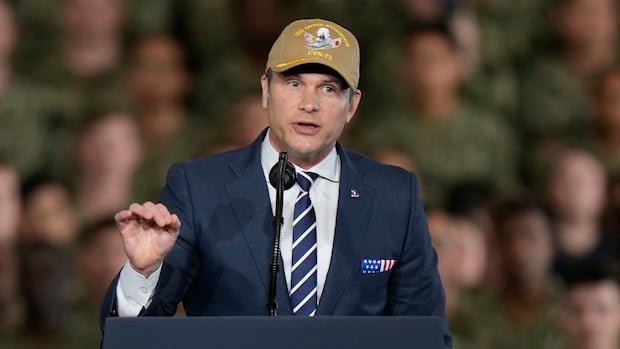

A set of strikes carried out by the U.S. military on vessels in the eastern Pacific Ocean resulted in the deaths of 14 individuals and one survivor, according to U.S. Defense Secretary Pete Hegseth. Hegseth alleged that the individuals aboard the vessels were involved in drug trafficking. Mexican authorities took charge of the search-and-rescue mission for the lone survivor following the three strikes on Monday. Hegseth mentioned that the vessels were identified by intelligence sources as traveling along known drug trafficking routes and transporting narcotics, although no evidence was provided.
A video shared by Hegseth showed two vessels close together in the water before exploding and another vessel exploding while in motion. Following a series of strikes in the Caribbean starting on September 2, the U.S. government revealed last week that the operations had expanded to Pacific waters. Concerns have been raised by experts regarding the legality of the strikes, which have resulted in the deaths of at least 57 people. There is no indication of alternative measures being taken to intercept the shipments, with the U.S. Coast Guard typically involved in drug interdiction efforts.
The recent strikes in the Pacific occurred amidst a U.S. military buildup in the Caribbean, including the presence of the aircraft carrier USS Gerald R. Ford, guided missile destroyers, F-35 fighter jets, a nuclear submarine, and approximately 6,500 troops. Speculation arose last week when the U.S. military flew supersonic heavy bombers near the coast of Venezuela, prompting questions about potential actions against Venezuelan President Nicolas Maduro. The Trump administration escalated efforts by increasing the reward for Maduro’s capture to $50 million and accusing the Tren de Aragua gang of operating under Maduro’s government.
While the administration has released videos of the strikes and claimed the targets were drug traffickers, there is a lack of information regarding the occupants of the vessels and the specific cargo onboard. It remains unclear whether any contraband seized was destined for the United States, as Trinidad and Tobago, near Venezuela, often serves as a transit point for packages bound for Europe or West Africa. The U.S. has experienced a significant number of drug-related deaths over the past decade, predominantly linked to opioid consumption with some cases involving cocaine adulterated with fentanyl. Colombia and Bolivia, neighboring Venezuela, are key coca plant producers for cocaine production.
U.S. Congress members, including some Republicans, have voiced concerns about the administration’s lack of transparency regarding the strikes. Republican Sen. James Lankford of Oklahoma criticized the limited information provided, highlighting a potential double standard in oversight. Despite such concerns, a Democratic-sponsored war powers resolution requiring congressional authorization for military strikes was voted down by the Republican-controlled Senate.
United Nations experts condemned the strikes as an “extremely dangerous escalation” with implications for regional peace and security in the Caribbean. They argued that the use of lethal force in international waters without legal justification violates international maritime law and constitutes extrajudicial executions. The experts emphasized the violation of Venezuela’s sovereignty and the U.S.’ international obligations not to interfere in domestic affairs or threaten armed force against another nation.
The actions have sparked international criticism, with leaders from Brazil, Colombia, and Mexico, as well as citizens from Colombia and Trinidad and Tobago, denouncing the strikes. Venezuela has condemned the military activities as provocations, leading to the suspension of energy agreements with Trinidad and Tobago. The situation has also drawn parallels with former Philippine president Rodrigo Duterte, who faces allegations of approving extrajudicial killings of drug offenders, raising concerns about accountability and legal implications in the U.S. military context.