


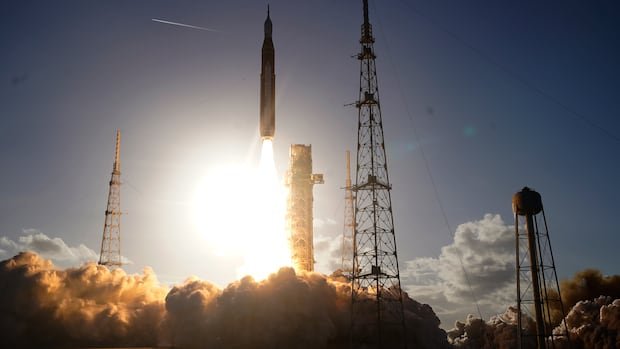

NASA’s Artemis program is making headlines with its objective to send astronauts on a journey around the moon. However, beyond this mission lies a broader strategic competition between the United States and China to land humans back on the lunar surface.
This new race is not just about planting flags and footprints. The country that achieves this feat first stands to gain an edge in selecting prime locations for future lunar infrastructure, shaping technical standards, and steering the next phase of space exploration.
During NASA’s recent Ignition event, officials emphasized the urgency of returning Americans to the moon before China, and specifically before the conclusion of U.S. President Donald Trump’s term. Jared Isaacman, the billionaire appointed by Trump to lead NASA, underscored the significance, stating, “NASA has committed to landing Americans on the moon before President Trump’s term ends, while our main competitor aims to do so before 2030.”
The competition is clearly underway on a political level. NASA is fast-tracking plans to land Americans on the moon by early 2028, whereas Wu Weiren, the chief designer of China’s lunar program, has assured that Chinese astronauts will step foot on the moon by 2030.
Casey Dreier, the chief of space policy at the Planetary Society, expressed skepticism about the feasibility of NASA’s 2028 target but acknowledged China’s role as a driving force for NASA and its allies.
Unlike the Apollo era, where the U.S. aimed for a quick lunar visit, the current race is viewed as a long-term endeavor focused on sustained presence rather than mere exploration. China’s track record of fulfilling its space ambitions lends weight to its 2030 lunar landing goal.
While some analysts believe that both the U.S. and China are destined to reach the moon, the timing of these missions remains crucial. The choice of landing sites near the moon’s south pole, where water ice may be found in shadowed craters, adds a geographic imperative to the competition. Water resources on the moon could potentially support life and serve as rocket fuel.
The urgency highlighted by Isaacman at the Ignition event underscores the need to expedite lunar missions rather than adhere to bureaucratic processes. The frequency of lunar expeditions could play a vital role in shaping the future of space travel and setting technical standards.
Funding poses a significant challenge for NASA, which has turned to private industry for support, particularly in developing spacecraft for lunar missions. The competition between SpaceX and Blue Origin to provide lunar landers reflects the reliance on private entities to achieve national space goals.
The involvement of private companies in space missions introduces a new dynamic to the space race, where international partnerships and commercial interests play a crucial role alongside state-driven programs like China’s.
Both the U.S. and China view the moon as a stepping stone for deeper space exploration, with Mars and beyond as the ultimate destinations. The race to establish a sustainable presence on the moon is seen as a critical milestone in humanity’s quest for space exploration.