


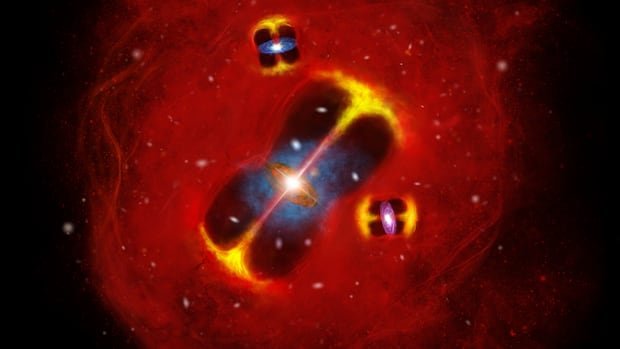

A group of international scientists, led by an astrophysicist from the University of British Columbia, has uncovered a youthful galaxy cluster emitting hot gas at a rate five times higher than previously believed possible. This finding has sparked enthusiasm among astrophysicists, as it has the potential to reshape scientific perspectives on the early universe following the Big Bang.
The research, featured in the Nature journal, involved a collaboration of more than two dozen researchers worldwide and focused on studying the SPT2349-56 galaxy cluster located approximately 12 billion light years away. The team, spearheaded by UBC PhD candidate Dazhi Zhou, identified a substantial amount of hot gas present in the intergalactic space.
Zhou remarked that this detection marked the first instance of such hot gas at such an early cosmic epoch, considering the galaxy cluster in question’s relatively young age in astronomical terms, forming just 1.4 billion years post-Big Bang. He expressed to CBC News that this discovery represents a significant advancement in understanding the universe’s fundamental workings.
James Di Francesco, director of the Dominion Astrophysical Observatory near Victoria, noted that conventional theories did not anticipate galaxy clusters reaching such high temperatures so quickly. Typically, the gas surrounding galaxies is expected to heat up gradually over time as galaxies move in orbits and release energy into their surroundings. The sudden and substantial heating of gas in this nascent cluster challenges previous assumptions, providing novel insights into cluster evolution.
The researchers believed that the quantity of hot gas observed was typically only expected to exist billions of years after the formation of the SPT2349-56 galaxy cluster. By leveraging various telescopes in Chile, the team delved into dark clouds, explored star formation, and investigated the universe’s earliest era.
Zhou explained that by utilizing radio telescopes observing in submillimeter and millimeter wavelengths, researchers could precisely determine the gas’s high temperature despite its vast distance from Earth. This innovative approach allowed them to obtain detailed insights into the cosmic phenomena under study.
A galaxy cluster comprises a gathering of galaxies, with clusters and superclusters potentially housing hundreds to thousands of galaxies. For instance, our own Milky Way resides in the Virgo supercluster, which could accommodate over 2,000 galaxies.
Zhou emphasized that this recent research holds crucial implications for comprehending contemporary massive galaxy clusters and their formation processes.