


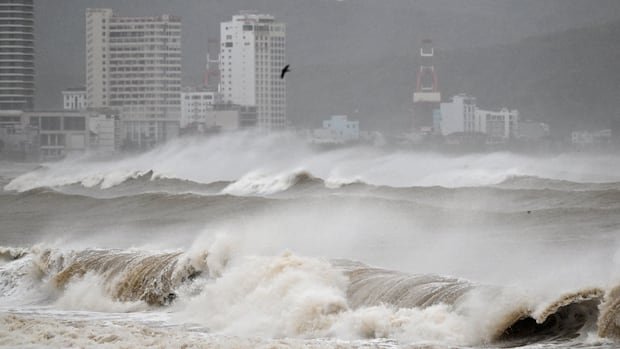

Typhoon Kalmaegi made landfall in Vietnam on Thursday, resulting in the cancellation of numerous flights and prompting authorities to advise residents to stay indoors. The storm, which had been moving through the Philippines for two days prior, claimed the lives of at least 114 individuals.
With winds reaching speeds of up to 149 kilometers per hour, Kalmaegi caused significant damage, including tearing roofs off houses, toppling trees and telegraph poles, and generating waves as high as 10 meters along the central coast. In response, six airports were closed, and over 260,000 individuals in Gia Lai province were relocated to safer areas.
This marks the 13th storm to impact Vietnam this year, with Kalmaegi being one of the most potent. Authorities mobilized over 268,000 soldiers for potential search and rescue missions, anticipating flooding in low-lying regions and potential agricultural disruptions, particularly in the Central Highlands, a key coffee-growing area.
Ahead of the storm, precautions were taken in vulnerable areas, such as the closure of establishments near Hoi An’s Cua Dai beach. Meanwhile, farmers near Hue were still recovering from recent floods that claimed the lives of 47 people.
Residents, like rice farmer Nguyen Van Rin, expressed concerns about further damage from Kalmaegi, especially given the losses they had already endured. As preparations continued, aviation authorities warned of likely disruptions at eight airports, including Da Nang’s international airport, urging airlines and local authorities to monitor the storm’s trajectory closely to ensure passenger safety.
In the aftermath of the storm’s impact in the Philippines, nearly two million people were affected, with over 560,000 individuals displaced, including around 450,000 seeking refuge in emergency shelters. President Ferdinand Marcos Jr. declared a state of emergency for the nation, particularly in the severely affected province of Cebu.
The destruction in Cebu became apparent as floodwaters receded, revealing flattened homes, overturned vehicles, and debris-strewn streets. Efforts to clear debris and aid in recovery were underway, with a focus on ensuring safety and facilitating relief operations for affected communities.
As the affected regions begin the recovery process, the threat of future storms looms, with meteorologists monitoring a developing system near Mindanao that could intensify into another typhoon. The aftermath of Kalmaegi adds to the challenges faced by the Philippines, coming shortly after a powerful earthquake struck the region, underscoring the resilience required in the face of natural disasters.