


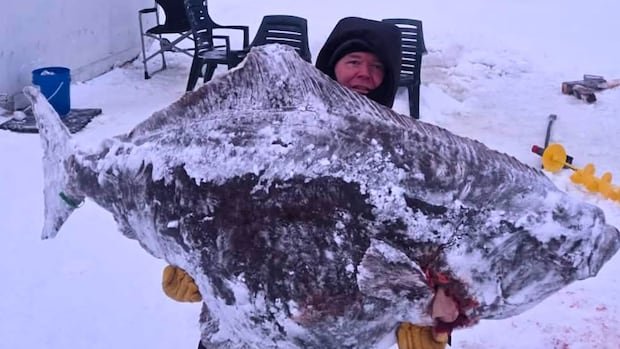

It took a Quebec ice fisherman two and a half hours to reel in a 244-pound halibut in the Saguenay Fjord, marking the largest Atlantic halibut ever documented in the region. “Fishing this species is quite challenging,” explained Marc-André Galbrand, the president of the basin committee, Comité de bassin de la Baie des Ha! Ha! (CBBH). He emphasized the need for patience and highlighted the physical toll it takes on anglers.
The massive halibut, measuring two meters in length, was caught by Alain Hamel in the L’Anse-Saint-Jean sector of the fjord, surpassing last year’s record of a 194-pound halibut. This fishing endeavor, conducted in collaboration with the local Fjord Museum, forms part of a scientific initiative aimed at enhancing our understanding of the species, Galbrand noted.
Although fishing for Atlantic halibut is prohibited in the Saguenay Fjord, participants in the project catch, tag, and deliver the fish to the museum for analysis. The bones in the fish’s head provide valuable insights into its migration patterns. The halibut, officially weighed on Monday, will be distributed among fishermen, with an estimated 170 pounds of delectable meat expected from this week’s haul.
Jérôme Rousseau also made a significant catch of an Atlantic halibut off the coast of Sainte-Rose-du-Nord on the Saguenay River this season, culminating a four-year engagement in the scientific fishing program involving over 1,200 hours of fishing. The halibut was promptly transported to the Fjord Museum for further examination.
Galbrand described the fishing activity as an “extreme sport,” emphasizing the need for expertise and caution due to the fish’s sharp teeth. The depth of the water, ranging from 120 to 180 meters, poses an additional challenge for anglers, requiring a careful and gradual retrieval process for halibut caught at significant depths.
Following the record-breaking catch, scientific fishing of Atlantic Halibut was temporarily halted in the fjord to adhere to the quota. Out of the 35 halibut authorized for scientific fishing, 27 have been captured, with plans to allocate the remaining permits through a lottery system, similar to restricted zones for other wildlife species.
Overall, the project serves as a platform for scientific exploration while offering participants the opportunity to savor the fruits of their labor through the consumption of the prized halibut meat.