


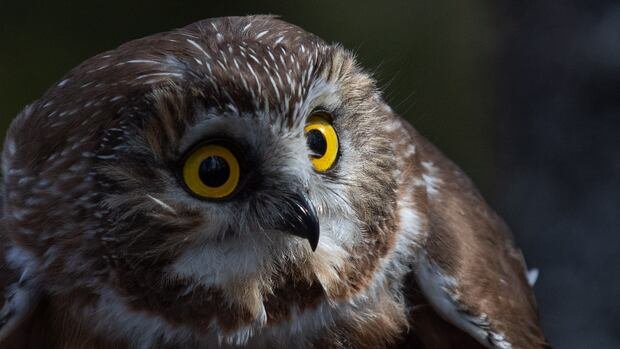

The heavy snowfall in Nova Scotia this winter is driving some of the smallest owls in the province to venture into more human-populated regions in search of food. The Northern saw-whet owl, which is tinier than a robin, is struggling to hunt its usual prey of mice, voles, and shrews due to the snow cover, according to Randy Lauff, a biology professor at St. Francis Xavier University specializing in boreal and Northern saw-whet owls.
Lauff emphasizes that owls, known for their excellent eyesight and hearing, possess remarkable hunting abilities. Larger owls can detect rodents moving beneath thick snow layers of 30 centimeters or more and use their size and strength to break through the snow for precise hunting. In contrast, the saw-whet owl’s small size limits its hunting capabilities in deep snow.
As a result of their food scarcity, saw-whet owls are being increasingly sighted this winter in both rural and urban areas with bird feeders. These owls are not attracted to the seeds but to the mice or small birds drawn to the feeders.
Hatfield Farm in Hammonds Plains, N.S., recently had a visit from a saw-whet owl for the first time. The owl sought shelter in one of the barns, perching in the rafters for a few days before moving on, likely in search of small prey around the barn due to the snowy conditions.
Cherie Hatfield, the farm owner, acknowledges the challenges predators face in finding food during the winter and highlights the importance of allowing wildlife their space and not causing them undue stress.
Lauff advises Nova Scotians who encounter saw-whet owls to observe them briefly, take photos if desired, and then give the bird its necessary space. In an effort to protect these stressed owls from disturbance, the Nova Scotia Bird Society recently prohibited members from posting saw-whet owl photos on their Facebook group.
The snowy conditions present both advantages and challenges for birds of prey, according to Hope Swinemar, founder of Hope for Wildlife in Seaforth, N.S. While the white snow makes prey more visible, icy crusts can hinder hunting efforts, potentially leading to increased starvation among predators. Swinemar notes that despite the harsh winter conditions, most birds and animals are resilient and adept at surviving in challenging environments.
It is essential to respect and protect wildlife during this time, allowing them the space and resources they need to thrive in their natural habitats.