


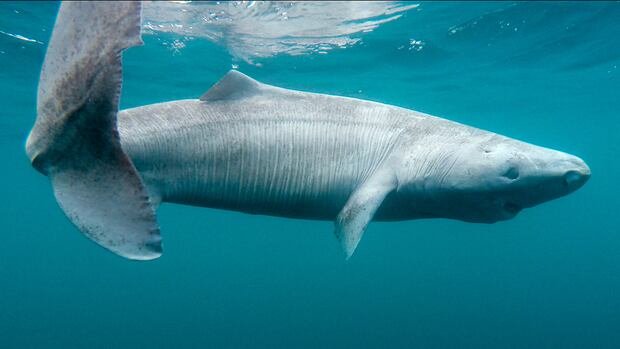

A rare and elusive Greenland shark has been discovered washed up on the coast of northwestern Ireland, leaving zoologist Emma Murphy astonished. Known for their elusive nature and usual habitat in the remote Arctic and North Atlantic oceans, the find has sparked excitement among researchers.
The National Museum of Ireland, where Murphy serves as a zoology curator, considers the Greenland shark species to be exceptionally rare in Irish waters, marking the first recorded stranding on Ireland’s coast. Despite its rarity in the region, one scientist suggests that the species may have a wider distribution than commonly believed.
Initially mistaken for a basking shark by onlookers near Sligo, the Greenland shark’s discovery was reported to the Irish Whale and Dolphin Group. After identification by scientists at the charity, the National Museum of Ireland was promptly informed.
The Greenland shark, one of the world’s largest carnivorous shark species after the great white shark, typically reaches lengths of three to five meters but can grow up to seven meters. Notably, it holds the title of the planet’s longest-lived vertebrate, with a lifespan exceeding 270 years, with some individuals estimated to live up to 400 years.
While the Greenland shark is primarily found in cold Arctic and North Atlantic waters, including regions like Quebec and Atlantic Canada, shark scientist Dean Grubbs suggests that their habitat range may extend further. Grubbs highlights that the species can tolerate cold temperatures under 6 degrees Celsius, allowing them to roam widely, potentially beyond known areas.
Greenland sharks, residing at depths of around 2,000 meters, are rarely encountered by humans due to their deep-sea habitat. Researchers have spotted them in various unexpected locations such as Belize and the Gulf of Mexico, indicating a broader distribution than previously assumed.
Despite the challenges of accessing their deep-sea environment, researchers were thrilled to observe the stranded Greenland shark up close in Ireland. The carcass was retrieved with the help of local volunteers and brought for further examination, revealing it to be a three-meter-long male close to sexual maturity, estimated to be around 150 years old.
The cause of death remains unknown, as the shark showed no signs of trauma or poor health. Though further tests are pending, researchers are preserving the shark’s skin and skull for public display at the National Museum of Ireland, ensuring that this remarkable specimen will be appreciated by future generations.