


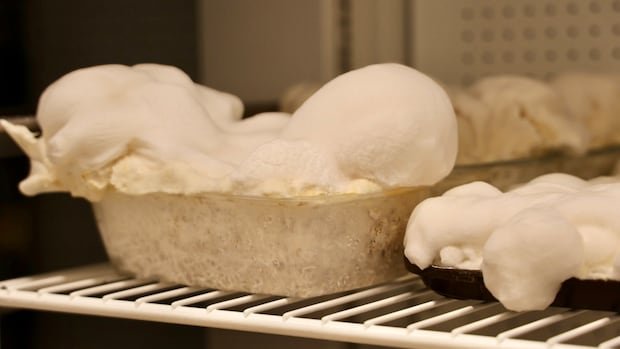

Deep in a dimly lit chamber within the depths of a research facility at Acadia University, a peculiar white substance emerges from an industrial tray. Resembling meringue, snow, or spray-foam insulation, this enigmatic living entity is mycelium, the foundational structure of a mushroom.
At Acadia, researchers have joined forces with an entrepreneur to refine a process that aims to utilize mycelium for producing a high-protein powder for the commercial food sector. Spearheaded by Katie McNeill, whose initial idea blossomed into this project, the team identified agricultural food products in the Valley going to waste and recognized their potential.
Inspired by literature suggesting mycelium’s potential for high-protein mushroom cultivation, McNeill, with an agricultural background, collaborated with Allison Walker, an Acadia biologist, to kickstart the initiative. By selecting specific food waste from a Valley facility and experimenting with various mushroom species, temperature variations, and humidity levels, they optimized the growth conditions.
The process involves creating a mycelium liquid broth mixed with food waste, nurturing the mycelium until it matures, and then transferring it to trays for growth. By halting growth before mushroom production, the entire cycle from inception to harvest spans roughly a week to 10 days.
Unlike traditional mushrooms with around 90% water content and about 2% protein, the mycelium produced by Walker and McNeill boasts a protein content of approximately 40%. Comparable to hemp protein and slightly below pea or soy isolates, their aim is to maintain a minimal processing approach, distinguishing their product from others in the market.
Mycaro, McNeill’s venture, prioritizes sustainability by utilizing agricultural food waste and minimizing energy consumption compared to conventional protein sources like meat, soy, or pea. Embracing indoor vertical farming techniques that require less energy, the operation benefits from the darkness in which mushrooms and mycelium thrive, reducing energy demands.
With a neutral taste profile, the mycelium protein product targets a growing consumer segment, particularly women seeking protein-rich options that are gentle on their bodies. The quest for protein alternatives beyond traditional options like whey, soy, or pea underscores the need for innovative products that resonate with consumer preferences.
Looking ahead, McNeill and Walker aim to enhance yield and conduct consumer testing in collaboration with Acadia’s food lab. By establishing a commercial production facility in the Valley by the end of 2026, the team envisions a phased expansion into a full-fledged operation. Funding from Invest Nova Scotia has kickstarted the research, with plans to seek additional investments in the near future.
As Mycaro advances towards commercial production, McNeill emphasizes the importance of meticulous growth room management due to mycelium’s finicky nature and the critical food safety and quality assurance standards that must be upheld. The journey from a mere dream to tangible progress underscores the excitement and potential of this innovative endeavor.