


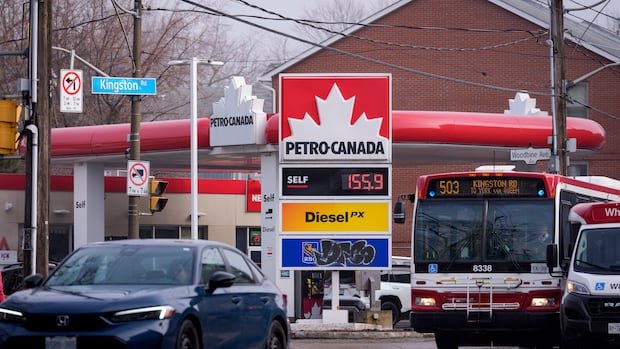

Canadians witnessed a surge in fuel prices nationwide this week due to escalating tensions in the Middle East driving up oil prices. As of Friday evening, average retail prices in Canada had reached 150 cents per litre, marking a significant increase from the 133.4 cents per litre recorded a week ago before the conflict erupted, according to data from GasBuddy.com. British Columbia registered the highest prices at 168.6 cents per litre.
The spike in prices follows the recent conflict between Israel, the United States, and Iran, resulting in retaliatory strikes that have claimed lives, led to evacuations, and triggered a humanitarian crisis. The ongoing war has disrupted oil tanker traffic in the vital Strait of Hormuz, a key passage for a fifth of the world’s oil supply.
Benchmark crude oil prices in the U.S. reached a two-year peak on Friday, with the cost per barrel surpassing $90 US for the first time since October 2023 as the conflict enters its second week.
Despite the turmoil, GasBuddy petroleum analyst Matt McClain reassured that there should be no actual fuel supply disruptions affecting Canada or the U.S. since both countries produce sufficient oil domestically. However, consumers may experience inconvenience or potentially higher costs depending on the conflict’s outcome.
Motorists filling up their tanks this week expressed concerns about the rising prices. Amy Gooding, a driver in the Greater Toronto Area, mentioned, “To me, I feel like I need gas regardless of the price. But I guess that cuts into other things that you could use the money for. We need to drive our car, so there’s not much we can do.”
In Saint John, N.B., Bailey Jones echoed similar sentiments while acknowledging the inevitability of price increases. She anticipated that prices are unlikely to decrease any time soon, stating, “It’s probably only going to get worse.”
Prices Expected to Remain Elevated
Warren Mabee, director of the Institute for Energy and Environmental Policy at Queen’s University, predicted that the escalated prices are likely to persist even if the conflict concludes within a few weeks as anticipated by U.S. President Donald Trump. Mabee highlighted that price disruptions tend to linger post-conflict, suggesting a few months of sustained price fluctuations.
While the extent of price increases remains uncertain, Mabee estimated that gas prices could surge by five to ten percent higher than pre-conflict levels.