


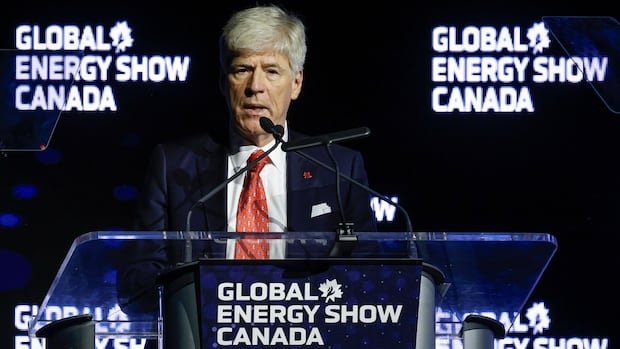

Federal Minister of Natural Resources Tim Hodgson delivered a message at the Global Energy Show in Calgary, emphasizing Canada’s potential as a reliable energy supplier in a volatile global landscape. However, the CEO of a prominent oilsands producer raised concerns about Canada’s commitment to a new West Coast oilsands pipeline, linking its support to a multibillion-dollar emissions-reducing initiative and an industry carbon levy.
Hodgson addressed the conference, highlighting Canada’s reliability, democratic principles, and renewed openness for business amidst ongoing geopolitical tensions in the Middle East. The event, expected to draw 30,000 attendees, saw an increased international presence compared to previous years.
Emphasizing the intersection of energy, economic, security, trade, and investment policies, Hodgson stressed that while the world does not wait for Canada, the country is actively seizing opportunities and rising to the occasion.
Last year, Alberta Premier Danielle Smith advocated for a new bitumen pipeline to the northwest coast, with the province aiming to submit an application by July 1 to the federal major projects office, despite lacking private-sector backing.
A comprehensive energy agreement between Alberta and Ottawa outlines conditions for the West Coast oil pipeline, contingent on advancing the Pathways carbon storage project. Cenovus Energy Inc. CEO Jon McKenzie acknowledged the collaborative efforts of federal and provincial governments but expressed reservations about the impact of a new carbon pricing regime on oilsands producers.
McKenzie criticized the industrial carbon tax, highlighting concerns about competitiveness and investment uncertainty in the Canadian energy sector. The Pathways project, spearheaded by Cenovus and other oilsands companies, aims to reduce carbon emissions by capturing and storing CO2 from multiple sites in Alberta.
However, McKenzie questioned the benefits and costs of the project, estimating a significant financial burden with minimal global emission reductions. He emphasized the challenging financial landscape for the pipeline’s realization and the need for a more competitive investment environment in the industry.
The Alberta government targets national interest designation for the pipeline by October, with construction potentially commencing as early as September 2027. Smith acknowledged the implementation challenges but expressed confidence in meeting targets and attracting investments once progress is evident.