


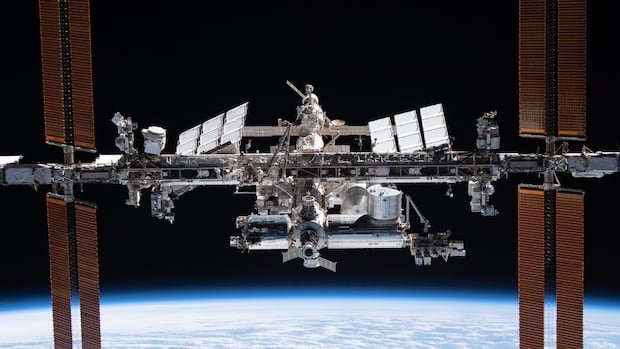

Historic structures, like Alexander Graham Bell’s residence in Nova Scotia, often transition into museums or national historic landmarks to safeguard their legacy for future generations. However, how can you conserve a structure the size of a football field orbiting 400 kilometers above Earth?
NASA’s official strategy is to intentionally crash the International Space Station (ISS) into a remote part of the ocean at the conclusion of its operational life. This approach involves a controlled reentry of the ISS into Earth’s atmosphere. Nonetheless, this week, certain U.S. Government members have proposed legislation that urges NASA to reassess this plan. They suggest exploring the possibility of maintaining the ISS in low Earth orbit instead.
Since 2000, the ISS has hosted hundreds of astronauts and cosmonauts from the U.S., Russia, Canada, Europe, and Japan, making it the most extensive scientific laboratory ever dispatched into space. Constructed incrementally through numerous space shuttle flights and Russian Proton and Soyuz missions, the ISS weighs over 400 metric tonnes and has accommodated countless experiments unique to a microgravity environment.
In January 2022, NASA disclosed its plan to retire the space station in 2030 and deorbit it in 2031. The current proposal involves utilizing a SpaceX rocket to guide the ISS on a trajectory through the atmosphere, causing it to disintegrate over a remote section of the Pacific Ocean. This mirrors the fate of the ISS’s predecessor, the Russian Space Station MIR, which submerged into the Pacific in 2001.
However, some individuals are not entirely convinced by this strategy. On February 4, U.S. Rep. George Whitesides, a former NASA chief of staff, presented a motion to the House Science, Space, and Technology Committee, advocating for exploring alternative options before committing the ISS to a fiery demise. The proposal passed its initial stage with bipartisan support.
Whitesides emphasized the unique engineering feat of the ISS and questioned whether it is prudent to dispose of such a significant asset without fully exploring the potential to preserve it in orbit for future use. Yet, the solution is far from straightforward.
The ISS cannot be left unattended for extended periods since it experiences atmospheric drag, gradually descending out of orbit if not regularly boosted. Neglecting maintenance could lead to the station’s deterioration, rendering it unusable or hazardous. Moreover, boosting the ISS to a higher orbit poses challenges due to potential collisions with space debris and the need for substantial fuel and larger rockets.
While NASA invited private entities to take over the ISS, no viable proposals materialized, suggesting that constructing a new space station may be more cost-effective than maintaining the existing one. Despite NASA’s focus shifting towards lunar and Martian missions, orbiting space stations like China’s Tiangong and upcoming private ventures indicate a continued interest in space exploration beyond the ISS era.
Rep. Whitesides’ bill to investigate alternative preservation methods for the ISS is still in progress, with NASA tasked to explore the feasibility of these ideas. Considering the complexities and expenses associated with conserving the ISS as a heritage site, it remains probable that after three decades of service, the $100 billion USD space laboratory will meet its end through atmospheric incineration and eventual submersion in the Pacific Ocean — unless a superior strategy emerges.