


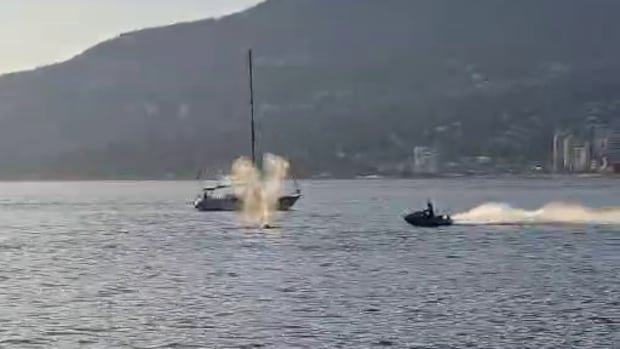

A rare appearance of a grey whale in the Vancouver waters has captured the attention of social media users and raised concerns after being struck by a Sea-Doo operator on Monday. Both Fisheries and Oceans Canada (DFO) and Vancouver police are conducting investigations, with officials noting that the whale seems unharmed and is behaving normally post-collision.
This incident follows a series of notable whale strikes last autumn, highlighting a growing issue identified by conservationists. To address potential conflicts on the water, it is crucial to understand the regulations in place.
Federal Marine Mammal Regulations mandate that vessels maintain a distance of at least 100 meters from whales, dolphins, and porpoises, extending to 200 meters if there is a calf present. For orcas in southern B.C. coastal waters, individuals must stay at least 400 meters away between Campbell River and Ucluelet, while a 1,000-meter distance will be enforced for endangered southern resident killer whales starting June 1.
Several small vessel restricted zones are designated to protect sensitive orca habitats around the Gulf Islands. While there is no specific speed limit for the waters off B.C.’s South Coast, recreational boaters are required to maintain a “safe speed” to prevent collisions, with specific speed limits in certain areas like 15 knots through the First Narrows and varying limits in other locations such as Port Moody and False Creek.
Enforcement of regulations is conducted by local police, port patrol, and the RCMP in Vancouver waters, with the DFO overseeing compliance with Marine Mammal Regulations, the Species At Risk Act, and the Fisheries Act. DFO’s whale protection unit, operating patrol vessels from Delta and Victoria, focuses on educating boaters about marine noise, vessel strikes, and ensuring safe distances from whales.
Penalties for violators can include charges under the Fisheries Act with fines up to $100,000. Despite existing regulations, there are challenges in enforcement due to gaps in the system, as DFO officers must follow legal processes to charge suspects and prove intent in approaching or disturbing animals.
The local whale populations in B.C.’s South Coast face various pressures. Humpbacks have shown significant recovery since whaling ceased but are still classified as a species “of special concern.” Bigg’s orcas are doing relatively better than endangered southern resident killer whales but remain listed as “threatened.” The endangered southern resident killer whale population is critically low, with only 73 individuals facing threats from reduced prey, marine noise, and environmental contamination.
The presence of the grey whale near Vancouver is unusual, believed to be part of a population facing food shortages due to climate change. Documenting the impact of ship strikes on whales remains challenging, with reported incidents likely underrepresenting the true scale of the problem.
Efforts to reduce conflicts include programs such as the ECHO initiative by the Port of Vancouver, which promotes voluntary slow zones and alternate routes for commercial vessels to protect marine life. The Whale Report Alert System by Ocean Wise alerts mariners to whale sightings to prevent potential collisions.
Addressing conflicts between recreational boaters and whales requires increased enforcement resources and public education. The Marine Education and Research Society offers a free Whale Safe Boating Course to enhance awareness and safety practices on the water. The goal is to foster a culture of whale-safe boating to protect marine mammals and reduce harmful interactions.