


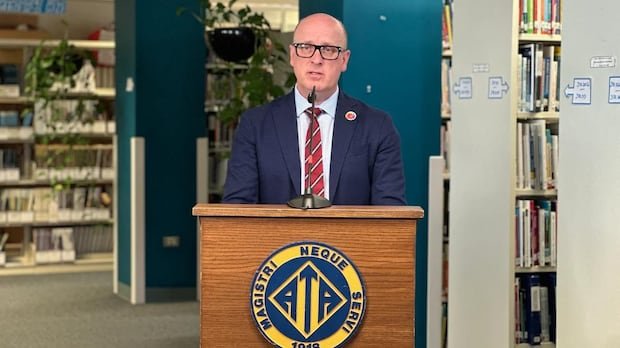

The Alberta Teachers’ Association is considering legal options to contest the back-to-work legislation enforced by the provincial government. ATA president Jason Schilling expressed determination to challenge what he views as an abuse of power by utilizing all available legal avenues.
Under the Back to School Act, the notwithstanding clause is invoked to prevent teachers from going on strike and to bar courts from overturning the law. The government defends this move as necessary to prevent localized strikes and maintain uninterrupted school operations.
While the ATA has not disclosed its specific plans, legal experts and civil liberty groups have been consulted to assess the potential for challenging the back-to-work order in court. The focus is on the notwithstanding clause, also known as Section 33 of the Canadian Charter of Rights and Freedoms, which allows legislation to bypass certain Charter provisions for up to five years.
Although laws upheld by the notwithstanding clause cannot be overturned, legal experts like Marion Sandilands point out that courts can still rule on whether such laws violate Charter rights, such as the right to collective bargaining. Recent cases in Saskatchewan and Quebec involving the notwithstanding clause have sparked legal debates on the extent of judicial review permitted when this clause is invoked.
Despite the limitations on striking down laws under the notwithstanding clause, legal experts suggest that challenging the legislation can still serve as a symbolic gesture and influence public opinion. The Alberta Teachers’ Association has stated its compliance with the law, with teachers already back in classrooms.
Criticism has been raised by the Canadian Bar Association’s Alberta branch regarding the preemptive use of the notwithstanding clause, arguing that it undermines the role of the judiciary in the legislative process. Concerns have been voiced about the potential undemocratic implications of invoking the notwithstanding clause without prior judicial scrutiny.
In response to the situation, the Canadian Civil Liberties Association has expressed interest in intervening if a legal challenge arises. Executive director Howard Sapers highlighted the problematic nature of using the notwithstanding clause in a manner that could erode confidence in democratic processes, such as the right to collective bargaining.