


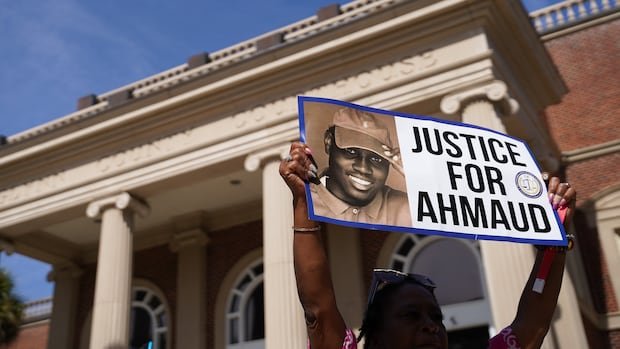

A U.S. federal appeals court has upheld the hate crime convictions of three white men who chased Ahmaud Arbery through a Georgia subdivision with pickup trucks before one of them fatally shot the Black man. The 11th U.S. Circuit Court of Appeals took more than a year to make its ruling after the defendants’ attorneys requested in March 2024 to overturn the case, arguing that the men’s history of racist text messages and social media posts did not prove they targeted Arbery based on his race. Federal prosecutors used these communications in 2022 to convince a jury that Arbery’s killing stemmed from “pent-up racial anger.”
The appellate panel’s opinion, authored by Judge Elizabeth L. Branch, indicated that prosecutors successfully demonstrated at the trial that each defendant harbored deep-seated prejudice, leading a reasonable juror to conclude that Arbery’s race was the primary factor in the deadly pursuit through the neighborhood. Despite the hate crime convictions being upheld, the three men are already serving life sentences for murder following their conviction in a Georgia state court.
Father and son Greg and Travis McMichael armed themselves and pursued 25-year-old Arbery in their pickup truck after spotting him running in their neighborhood near Brunswick on Feb. 23, 2020. A neighbor, William (Roddie) Bryan, joined the pursuit and recorded a video of Travis McMichael fatally shooting Arbery at close range. The video prompted national outrage after its online leak, leading to the Georgia Bureau of Investigation taking over the case from local authorities.
All three men were found guilty of murder in a state court in late 2021. In early 2022, a U.S. District Court jury convicted them of hate crimes and attempted kidnapping following a second trial. The defense attorneys for Bryan and Greg McMichael criticized the prosecution’s use of social media posts and text messages containing racist language, arguing that these influenced the jury without proving a direct racist intent towards Arbery.
The 11th Circuit judges rejected the defense’s claims, emphasizing that there was no evidence linking Arbery to any criminal activity in the neighborhood, as he was unarmed and did not possess stolen items when he was killed. Travis McMichael’s attorney did not contest his client’s racist motivation but rather focused on legal technicalities, arguing that the streets where the incident occurred were not public roads as stated in the indictment. This argument was also dismissed by the appeals court.
The trial judge sentenced both McMichaels to life imprisonment for their hate crime convictions, with additional years added for brandishing firearms during violent acts. Bryan received a 35-year hate crime sentence, a shorter term due in part to his lack of armament and his role in preserving the crucial cellphone footage.