


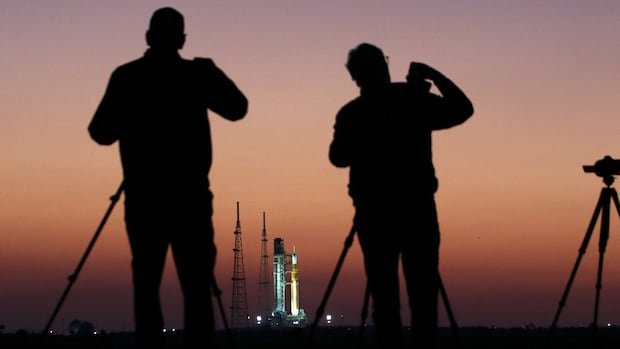

Artemis II’s upcoming circumnavigation of the moon and return marks a significant milestone in human space exploration, potentially pushing the boundaries of our reach farther into space than ever before. CBC News is set to provide extensive coverage of the mission, following the journey of four crew members, including Canadian Space Agency astronaut Jeremy Hansen and NASA astronauts Reid Wiseman, Victor Glover, and Christina Koch.
The crew will embark on their expedition aboard the Space Launch System (SLS) rocket and the Orion spacecraft, launching from Kennedy Space Center’s Launch Pad 39B in Florida. The mission’s launch timing is critical, with multiple opportunities or launch windows available, subject to risk assessments and system checks. Previous launch attempts in February and March were postponed due to hydrogen and helium issues, but NASA is optimistic about an 80% chance of a successful launch on April 1.
The first launch window is scheduled for Wednesday, April 1, from 6:24 p.m. to 8:24 p.m. ET, with subsequent opportunities available each night from Thursday, April 2, to Monday, April 6. To achieve the desired trajectory to the moon and back, the launch is planned for nighttime for East Coast viewers.
As the mission unfolds, NASA’s detailed countdown minutes before liftoff can be accessed for those interested. CBC’s team, including Science reporter Nicole Mortillaro, reporters Paul Hunter, and Karen Pauls, will provide comprehensive coverage across radio, TV, and digital platforms. Live online coverage will commence two hours before the launch on CBCNews.ca, offering a livestream of the event and real-time updates.
For those eager to witness the Artemis II launch firsthand, opportunities are open to share experiences by contacting ask@cbc.ca. Additionally, CBC programs such as Hanomansing Tonight and The National will broadcast live specials from Kennedy Space Center, with coverage starting on March 31 on CBC News Network and CBC Radio.
Artemis II’s mission aims to test essential systems and astronaut responses during a trajectory around the moon without landing. Originally intended as a prelude to Artemis III’s moon landing mission in 2028, NASA recently revised its plans, redirecting Artemis III to a low-Earth orbit test and designating Artemis IV for the lunar surface landing.
The Artemis missions represent NASA’s commitment to sustained lunar presence, scientific exploration, and economic endeavors, with the ultimate goal of advancing human exploration to Mars. NASA Administrator Jared Isaacman’s accelerated plans for a moon base and adjustments to the Lunar Gateway project emphasize the agency’s determination to lead in space exploration. The urgency is underscored by China’s progress in lunar exploration, with aspirations to land its astronauts on the moon by 2030.
As Artemis II embarks on its approximately 10-day mission before returning to Earth, the focus remains on progressing step by step towards broader space exploration goals.