


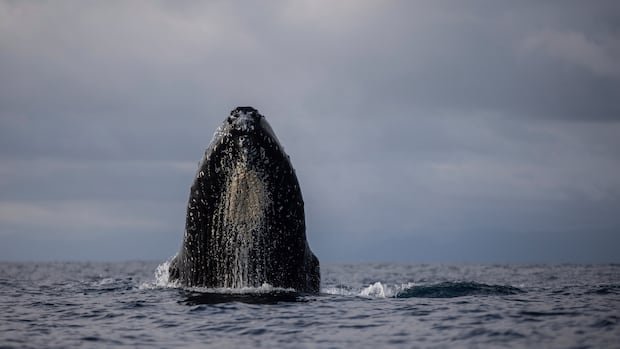

Whale Songs: A Mystery Unraveled
Eduardo Mercado, a bioacoustician, was captivated by the mesmerizing sounds of humpback whale songs when he first encountered them. Unlike the common belief that these songs serve as mating calls, Mercado speculated whether the whales were using their songs for echolocation, akin to dolphins. This curiosity led him on a lifelong journey to decode the true purpose behind these enigmatic sounds.
Mercado, a professor at the University of Buffalo, delves into his extensive research in his new book titled “Why Whales Sing.” In a discussion with host Bob McDonald on “Quirks & Quarks,” Mercado sheds light on the intriguing topic.
Whale songs differ from human or bird songs as they do not have a definite start or end. Humpback and other baleen whales can sing continuously for hours, cycling through a fixed sequence of patterns akin to an acoustic carousel without a clear beginning or end.
Contrary to the traditional belief that whales sing for courtship, Mercado proposes in his book that these songs are a form of echolocation, similar to bats but on a broader spatial scale. The purpose is not to perform for other whales but to explore and create an internal map of their surroundings.
While many scientists argue that whale songs are courtship rituals due to the predominance of male singers during breeding contexts, Mercado’s research revealed a different perspective. He noticed a significant evolution in the sounds used within songs over time, suggesting a purpose beyond mere display for mating.
Drawing inspiration from his study of dolphin echolocation, Mercado found parallels between whales’ echolocation behaviors and those of bats, reinforcing his theory. Through experiments and analysis of sound physics, he demonstrated the feasibility of whales detecting objects kilometers away using their songs as sonar.
Beyond analyzing whale sounds, Mercado’s research focuses on how learning shapes the brain’s response to sound in mammals, including humans. The ability of whale sounds to travel vast distances underwater, reaching up to 1000 kilometers in some species, further supports the theory of echolocation.
By interpreting the nature of whale sounds, Mercado suggests that whales primarily focus on large moving targets, particularly other whales. In their nomadic lifestyle, where encounters are rare and individuals are constantly on the move, whales use sound to monitor their surroundings and social interactions over vast ocean expanses.
In conclusion, the enigmatic whale songs that have puzzled scientists for decades may hold the key to a sophisticated form of echolocation rather than mere courtship displays. Eduardo Mercado’s groundbreaking research challenges conventional beliefs and opens new avenues for understanding the communication and navigational prowess of these majestic marine creatures.