


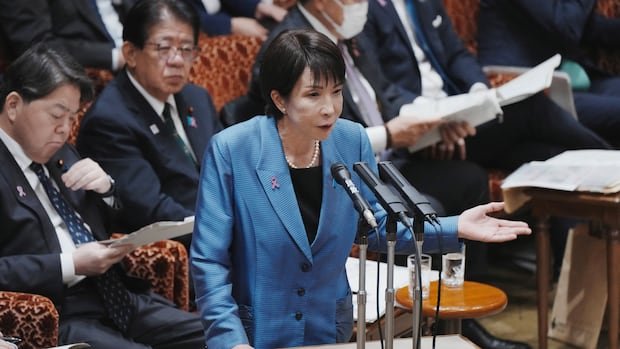

Japan has advised its citizens in China to increase safety measures and steer clear of crowded places amidst escalating tensions between the two largest economies in Asia over statements made by Japanese Prime Minister Sanae Takaichi regarding Taiwan. Takaichi triggered a significant diplomatic dispute when she informed Japanese lawmakers about the possibility of a military response from Japan in the event of a Chinese attack on Taiwan that could threaten Japan’s survival.
The ongoing dispute could have negative implications for Japan’s economy, as Beijing has recommended its citizens to avoid traveling to Japan. Chinese tourists constitute a substantial portion of visitors to Japan, making up nearly a quarter of all tourists, according to official data. Following the news, stocks related to tourism in Japan experienced a significant decline.
Several Chinese airlines, including Air China, China Eastern Airlines, and China Southern Airlines, have offered refunds for routes bound for Japan until December 31. Additionally, Sichuan Airlines has postponed its plans for a Chengdu-Sapporo route until at least March, as reported by state media.
Efforts to ease tensions were made as a senior Japanese official met with his counterpart in Beijing on Tuesday. However, no immediate breakthrough was reported from the discussions.
During her appearance before a parliamentary committee on November 7, Takaichi emphasized potential scenarios that could prompt a Japanese military response, citing a Chinese naval blockade or other actions against Taiwan. Her comments were notably more assertive compared to those made by her predecessors, who had expressed concerns about China’s threat to Taiwan without publicly stating Japan’s potential response.
China claims Taiwan as its own territory and has not ruled out using force to assert control over the island, a claim rejected by Taiwan’s government. China’s Foreign Ministry called for Takaichi to retract her remarks during the meeting, but Japan’s top government spokesperson, Minoru Kihara, indicated that Tokyo had no intention of doing so. Kihara reiterated the government’s stance and expressed hope for the peaceful resolution of Taiwan-related issues through dialogue.
In response to Takaichi’s statements, a Chinese diplomat in Japan made a threatening social media post directed at her, drawing a strong rebuke from Tokyo. Despite Tokyo’s response, Chinese state media continued to criticize Takaichi.
As tensions persist, Japan’s embassy in China issued a reminder for Japanese citizens to respect local customs, exercise caution in interactions with Chinese individuals, and remain vigilant in public spaces. The embassy advised citizens to avoid traveling alone, be alert to their surroundings, and to promptly leave any area that appears suspicious.
The escalating diplomatic row has also impacted cultural exchanges, with film distributors in China suspending the screening of at least two Japanese films. This decision was praised by China’s state broadcaster CCTV as a prudent measure reflecting the changing sentiment within the country.
Aside from the tourism sector, Japan heavily relies on China for the supply of essential minerals used in various industries, from electronics to automotive manufacturing. Japan’s economic security minister, Kimi Onoda, highlighted the risks associated with economic dependency on a country that resorts to economic coercion. The minister stressed the need to recognize such risks, particularly in light of China’s recent calls for its citizens to avoid traveling to Japan.
Japanese Trade Minister Ryosei Akazawa noted that there have been no significant changes in China’s export control measures on rare earths and other materials. The heads of Japan’s three business federations met with Takaichi to advocate for dialogue as a means to resolve the diplomatic tensions.
The geographical proximity of Taiwan to Japan underscores the strategic importance of the region for Tokyo’s trade activities. Japan also hosts the largest U.S. military presence overseas. Recent incidents in disputed waters, involving Chinese coast guard ships near islands controlled by Japan but claimed by China, have further heightened tensions in the region.
The United States, while not formally recognizing the disputed islands, has reiterated its commitment to defend Japan under the Japan-U.S. security treaty. The U.S. ambassador to Japan, George Glass, reaffirmed this commitment, stating that the United States remains dedicated to Japan’s defense, including in the case of any threat to the Senkaku Islands.
Chinese Foreign Ministry spokesperson Mao Ning dismissed Glass’s remarks as a politically motivated spectacle during a news conference, underscoring the complex dynamics at play in the ongoing diplomatic tensions between China, Japan, and the United States.