


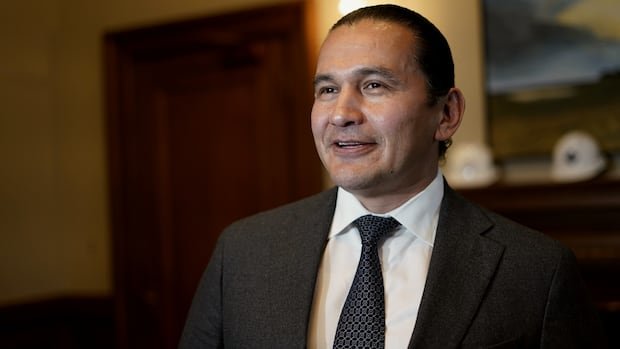

Manitoba Premier Wab Kinew sparked a debate on Monday by criticizing a recent Supreme Court of Canada decision on child pornography and suggesting that offenders should be placed beneath prisons. Kinew, addressing reporters, emphasized the severity of child sexual abuse images and videos, stating that those responsible should not only face lengthy prison sentences but also be integrated into the general prison population without protective custody.
The Supreme Court ruling, which declared the one-year mandatory minimum jail terms for child pornography offenses as unconstitutional, has drawn criticism from conservative figures such as Opposition Leader Pierre Poilievre, Alberta Premier Danielle Smith, and Ontario Premier Doug Ford. These politicians have urged Ottawa to override the decision using the notwithstanding clause, a mechanism that allows governments to bypass certain sections of the Charter of Rights and Freedoms.
Kinew, a member of the New Democratic Party, aligned himself with Smith, Ford, and others, expressing his disagreement with the court’s decision and describing it as “disgusting.” He also used the term “skinners” to refer to sex offenders. However, Kinew’s remarks faced backlash from the Criminal Defence Lawyers Association of Manitoba, which deemed his comments unhelpful and urged him to exercise caution in his statements.
The association criticized Kinew for advocating vigilante justice, emphasizing that the legal system is designed to ensure fair treatment and appropriate sentencing for all individuals. They highlighted Kinew’s previous controversial statements regarding the justice system, including his apology to defense lawyers for remarks made during the expulsion of a fellow NDP member.
In a separate legislative move, Kinew introduced a bill requiring judges to provide input whenever the Manitoba government invokes the notwithstanding clause to override Charter rights. Although judges would not have the authority to block such actions, they would be tasked with assessing the constitutionality of the bill in the absence of the notwithstanding clause.
With recent criticism directed at Quebec, Alberta, and Saskatchewan for their use of the notwithstanding clause to curtail the rights of vulnerable groups, Kinew has been vocal in denouncing these measures. Notable instances include Saskatchewan’s restriction on name and pronoun changes for minors without parental consent, Alberta’s legislation compelling striking teachers to return to work, and Quebec’s ban on certain public sector workers from wearing religious symbols while on duty.