


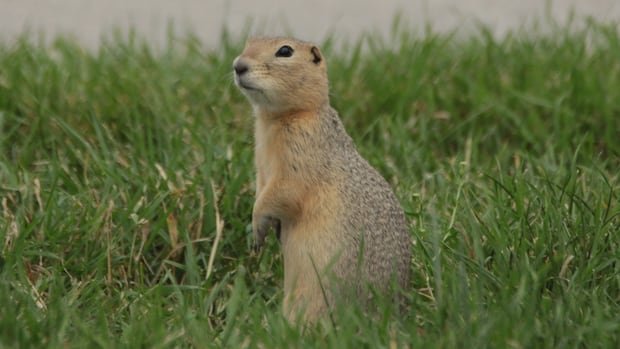

Farmers are facing a challenge with gophers, also known as Richardson’s ground squirrels, that cause significant damage to crops and equipment. The ban on using strychnine to control gopher populations due to its harmful effects on wildlife has led to alternative solutions being sought.
In response to the need for gopher control, the Saskatchewan Wildlife Federation (SWF) has initiated a free gopher control program. Todd Smith, the executive director of SWF, mentioned that the program was developed based on farmers’ requests over the past couple of years.
The program involves volunteers who are coordinated based on farmers’ requests for assistance. These volunteers, covered by liability insurance, aim to tackle the gopher issue in a responsible and ethical manner. However, some believe that the program may not fully address the broader problem of gopher overpopulation.
James Husband, reeve of the Rural Municipality of Hazelwood, highlighted concerns about the program’s effectiveness in controlling gopher populations. He emphasized the need to address gophers’ breeding habits to curb their exponential growth.
Edmond Sanganyado, an associate professor at the University of Saskatchewan, suggested shooting gophers as a more humane alternative to poisoning. He explained that shooting can lead to quicker and more humane deaths compared to the effects of strychnine poisoning, which causes convulsions and seizures.
The optimal time for gopher hunting is when adult males emerge in mid-February to early March, followed by females in mid-March. Acting before the kits are born can help mitigate the impact of gophers on crops. Some farmers have turned to using zinc phosphide as an alternative to strychnine, although it is considered less effective and more labor-intensive.
Overall, the efforts to manage gopher populations are ongoing, with various methods being explored to protect farmers’ livelihoods from the destructive impact of these pests.