


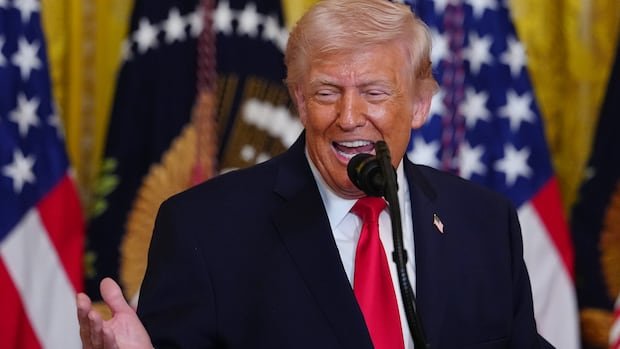

The Trump administration has broadened its investigation into trade matters to encompass 60 nations, including Canada, in a bid to reinforce the tariff policies of the U.S. president.
U.S. Trade Representative Jamieson Greer stated to CNBC on Friday, “We are aiming to act swiftly, within a matter of months.”
An announcement from Greer’s office on Wednesday revealed the initiation of inquiries into the European Union and a few other countries under Section 301 of the Trade Act of 1974.
A news release on Thursday evening from the office expanded the roster of countries under scrutiny. The release highlighted that the department would scrutinize whether the named countries have implemented policies or practices that are deemed “unreasonable or discriminatory and that impede or restrict U.S. commerce.”
Recently, the U.S. Supreme Court invalidated President Donald Trump’s preferred tariff mechanism, which he utilized for tariffs linked to “Liberation Day” and fentanyl-related duties on Canada, Mexico, and China.
Following the court ruling, Trump imposed a 10% global tariff using Section 122 of the 1974 Trade Act. These tariffs do not affect goods compliant with the Canada-U.S.-Mexico Agreement (CUSMA) on trade.
Under Section 122, tariffs can only be raised to 15% and expire after 150 days unless Congress decides to prolong them, a scenario unlikely to garner Congressional approval.
Canada is also grappling with Trump’s separate Section 232 tariffs on specific sectors such as steel, aluminum, automobiles, and cabinetry.
Trump aims to implement longer-term tariffs through Section 301 investigations, a process that necessitates public consultations and reports.
Greer emphasized that if unfair trading practices, like subsidies, excess capacity, or forced labor, are discovered in countries, the harm to U.S. commerce can be quantified to address these issues with the concerned country.
In cases where the issue remains unresolved, Greer mentioned that the Trump administration would impose tariffs.
The scope of the 301 investigation into Canada remains ambiguous. Persistent challenges exist in the Canada-U.S. trade relationship, with Trump frequently criticizing Canada’s dairy supply management system.
The launch of the 301 investigations coincides with the upcoming mandatory review of CUSMA by Canada, Mexico, and the U.S.
Trump has expressed skepticism about the trade pact, negotiated during his first term, referring to it as “irrelevant” and suggesting it may have served its purpose.
Formal negotiations on the CUSMA review have been initiated by the U.S. with Mexico, a country also subject to a 301 investigation. However, no similar action has been announced by Ottawa and Washington.
Although Greer has often claimed that Canada poses barriers to negotiations, citing provincial restrictions on U.S. alcohol sales, he recently met with Canada’s new trade team in Washington.
During the meeting, Canada’s chief trade negotiator Janice Charette, newly appointed Ambassador to the U.S. Mark Wiseman, and Canada-U.S. Trade Minister Dominic LeBlanc were in attendance.