


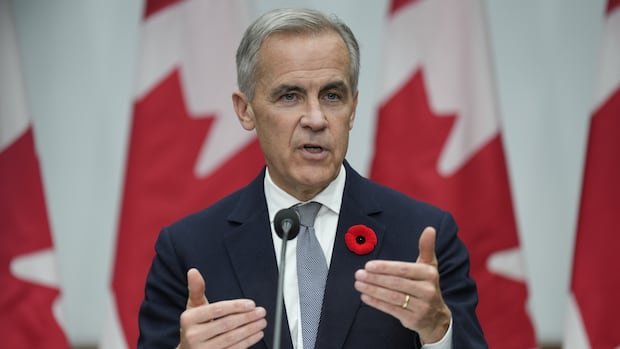

Prime Minister Mark Carney indicated on Saturday his readiness to potentially face an election over his government’s forthcoming budget if necessary. The budget is set to be presented in the minority Parliament on Tuesday, with uncertainty looming over whether the Liberals have the backing of opposition parties.
Speaking at the conclusion of the APEC summit in South Korea, Carney highlighted the advantages of the government’s planned investments and future initiatives. However, he refrained from directly addressing whether there is sufficient support in the House of Commons to pass the budget.
“I am fully confident that this budget is the appropriate one for our country at this particular time,” Carney stated before departing for home. He emphasized the significance of the current global economic situation and its critical impact on Canada.
A failure to secure approval for the budget would trigger a snap election, just over six months after the last campaign. When asked if he was prepared to face an election over the upcoming fiscal plan, Carney asserted, “I’m always ready to stand up for what is right.”
Carney announced that the Liberals will initiate a series of “generational investments” in the Canadian economy and infrastructure. He aims to revamp the presentation of federal finances and commit to balancing Canada’s operating account within three years.
The Conservatives and the NDP are deliberating their strategies over the weekend. The Conservatives are grappling with the dilemma of endorsing a policy agenda they oppose, with sources indicating a reluctance to trigger an election unless compelled to do so. Conservative Leader Pierre Poilievre has outlined demands, including abolishing the industrial carbon tax and maintaining the deficit below $42 billion.
For the New Democrats, aligning with the Liberals may pose greater challenges. Carney’s proposal includes heightened defense spending while requiring other government sectors to make 7.5% program cuts in the upcoming fiscal year, escalating to 15% by 2028-29.
In a separate development, Carney acknowledged apologizing to U.S. President Donald Trump for Ontario’s anti-tariff advertisements that disrupted trade negotiations. Carney expressed regret over the ad campaign and emphasized his responsibility as prime minister in managing relations with the U.S.
The Ontario government aired a television ad in the U.S. featuring excerpts from former President Ronald Reagan’s 1987 radio address on free trade. The ad prompted criticism from the Ronald Reagan Presidential Foundation and Institute, leading to Trump terminating trade talks with Canada.
The situation remains fluid as the opposition parties evaluate their options and the government braces for a critical budget showdown.